 Back
Derivatives of Exponential and Logarithmic Functions: Business Calculus Study Guide
Study Guide - Smart Notes
 Tailored notes based on your materials, expanded with key definitions, examples, and context.
Additional Derivative Topics
Derivatives of Exponential and Logarithmic Functions
This section explores the differentiation of exponential and logarithmic functions, which are fundamental in business calculus for modeling growth, decay, and financial applications. Understanding these derivatives is essential for analyzing rates of change in various business contexts.
The Derivative of the Exponential Function
Definition: The exponential function is unique because its derivative is itself.
Formula:
Key Properties:
The exponential function grows rapidly as x increases.
When using calculators, always use the designated 'e' for the exponential function.
The power rule does not apply to ; use the exponential rule instead.
Example: If , then .
Derivatives of General Exponential Functions
Definition: For any positive base , the function is an exponential function.
Formula:
Application: Used in modeling population growth, compound interest, and other business phenomena.
Example: If , then .
Review of Properties of Logarithmic Functions
Logarithmic functions are the inverses of exponential functions and are widely used in business calculus for modeling phenomena such as price elasticity and information growth.
Definition: For , , the logarithmic function is .
Inverse Relationship: is equivalent to .
Domain and Range:
Domain of :
Range of : All real numbers
Domain of : All real numbers
Range of :
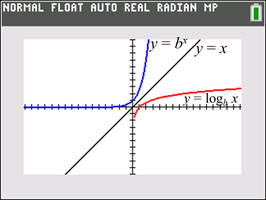
Graphical Symmetry: The graphs of and are symmetric with respect to the line .
Derivative of the Natural Logarithm
Definition: The natural logarithm is the logarithm with base .
Formula:
Key Properties:
The derivative is only defined for .
Used in modeling growth rates and elasticity in economics.
Example: If , then .
Derivatives of Logarithmic Functions with Other Bases
Formula:
Change of Base:
Application: Useful for converting between logarithms of different bases in business and financial calculations.
Summary Table: Derivatives of Exponential and Logarithmic Functions
Function | Derivative |
|---|---|
Applications of Exponential and Logarithmic Derivatives
Exponential and logarithmic derivatives are used in a variety of business applications, including demand modeling, compound interest, and franchise growth analysis.
Example: Price Demand Equation
Scenario: An online store sells guitar strings. The price demand equation relates price to the number of sets sold .
Task: Find the rate of change of price with respect to demand when .
Interpretation: The price per set is decreasing at a rate of about 2 cents per set when the demand is 100 sets.
Example: Continuous Compound Interest
Scenario: An investment of earns interest at an annual rate of 4% compounded continuously.
Formula: The amount at time is .
Instantaneous Rate of Change:
Example: After 2 years, the account balance is growing at per year.
When balance is : The rate of change is per year.
Example: Logarithmic Growth Model
Scenario: A sandwich shop franchise grows according to a logarithmic model.
Task: Estimate the number of locations in 2028 ().
Result: Approximately 1,101 locations in 2028.
Rate of Change: The number of locations is growing at a rate of 10 per year in 2028.
Summary
Understanding the derivatives of exponential and logarithmic functions is crucial for business calculus students. These concepts are applied in modeling growth, decay, demand, and financial scenarios. Mastery of these derivatives enables effective analysis and interpretation of real-world business problems.
