 Back
Derivatives of Exponential (Base-e) Functions in Business Calculus
Study Guide - Smart Notes
 Tailored notes based on your materials, expanded with key definitions, examples, and context.
Derivatives of Exponential (Base-e) Functions
Exponential Functions: Definition and Properties
Exponential functions are fundamental in calculus and business applications, modeling growth and decay processes. An exponential function is defined as:
General Form: , where and .
Base : The constant is called the base of the exponential function.
Behavior: The function is continuous and positive for all real .
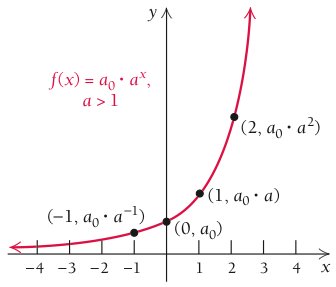
Case 1: If , the function is increasing and concave up. As decreases, approaches 0, and the x-axis is a horizontal asymptote.
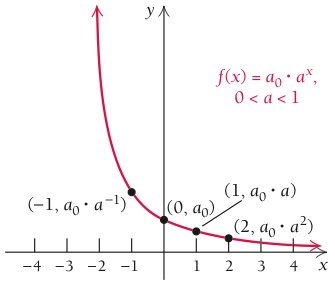
Case 2: If , the function is decreasing and concave up. As increases, approaches 0, and the x-axis is a horizontal asymptote.
The Natural Base
The number is a special constant in mathematics, approximately , defined by:
is called the natural base and is used in natural exponential functions.
Derivative of the Natural Exponential Function
The derivative of the natural exponential function is unique because it is equal to the function itself:
In general, for
Derivative of to a Function
When the exponent is a function of , the derivative is the product of to that function and the derivative of the exponent:
This is a direct application of the chain rule.
Examples of Differentiation
Example 1: Differentiate
Example 2: Differentiate
Example 3: Differentiate
Use the product rule:
Example 4: Differentiate
Applied Example: Business Context
Pelican Fabrics purchases a new video surveillance system. The value of the system , in dollars, years after purchase is modeled by:
Estimating Value After 5 Years: Substitute into the formula.
Rate of Change After 5 Years: Compute and evaluate at .
Example:
At :
Summary Table: Properties of Exponential Functions
Base | Behavior | Asymptote | Concavity |
|---|---|---|---|
Increasing | x-axis | Up | |
Decreasing | x-axis | Up |
Practice Problems
Textbook/Study Plan Practice Problems: 1–23 odd, 55, 75
