 Back
BackDifferentials and Increments in Business Calculus
Study Guide - Smart Notes
 Tailored notes based on your materials, expanded with key definitions, examples, and context.
Section 6: Differentials
Introduction to Differentials
Differentials provide a method for approximating small changes in a function's value based on its derivative. This concept is essential in business calculus for estimating changes in cost, revenue, and profit functions when the input variable changes by a small amount.
Increments and the Difference Quotient
Definition of Increments
Increment in x (Δx): The change in the independent variable x, denoted as Δx = x_2 - x_1.
Increment in y (Δy): The corresponding change in the dependent variable y, given by Δy = f(x_2) - f(x_1) = f(x_1 + Δx) - f(x_1).
The difference quotient is written as , which approaches the derivative as Δx approaches 0.
Example: For , if x changes from 2 to 2.1, then and .
Graphical Interpretation of Increments
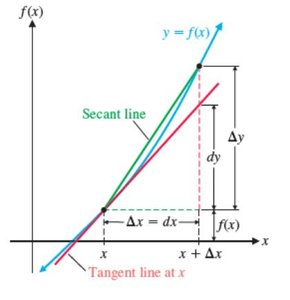
Increments can be visualized on the graph of a function. The secant line connects two points on the curve, and its slope is given by the difference quotient. The tangent line at a point approximates the curve near that point, and its slope is the derivative.
Differentials: Definition and Calculation
Definition of the Differential
If is differentiable, the differential is defined as , where is a small change in x.
The differential approximates the actual change for small .
Symbolically:
or
Interpretation of Differentials
Δx and dx both represent a change in x.
Δy is the actual change in y, while dy is the approximate change in y, estimated using the derivative.
For small changes, .
Example: Calculating Differentials
Find for at and .
For ,
Comparing Increments and Differentials
Example: Quadratic Function
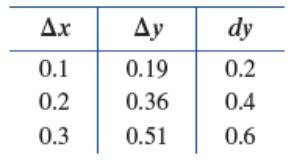
Let . Find and for and various values of .
At ,
The following table compares and for different values of :
Δx | Δy | dy |
|---|---|---|
0.1 | 0.19 | 0.2 |
0.2 | 0.36 | 0.4 |
0.3 | 0.51 | 0.6 |
Applications in Business: Cost, Revenue, and Profit
Using Differentials for Approximation
Differentials are useful for estimating changes in business functions such as cost, revenue, and profit when production levels change slightly.
Cost function:
Revenue function:
Profit function:
Example: Estimate the change in revenue and profit if production increases from 2,000 to 2,010 units per week ().
At ,
At ,
Thus, the differential provides a quick estimate of the change in revenue and profit for a small increase in production.
Additional info: The use of differentials is foundational in business calculus for making rapid, approximate calculations that inform managerial decisions, especially when exact computation is complex or unnecessary for small changes.
