 Back
BackExam 3 Review: Derivatives, Increasing/Decreasing Functions, and Local Extrema
Study Guide - Smart Notes
 Tailored notes based on your materials, expanded with key definitions, examples, and context.
Derivatives and Function Behavior
Understanding the Role of the First Derivative
The first derivative of a function provides critical information about the function's behavior, specifically where it is increasing or decreasing. By analyzing the sign of the first derivative, we can determine intervals of increase and decrease, as well as identify local maxima and minima.
Increasing Function: A function is increasing on intervals where its first derivative is positive ().
Decreasing Function: A function is decreasing on intervals where its first derivative is negative ().
Local Maximum: Occurs at a point where the first derivative changes from positive to negative.
Local Minimum: Occurs at a point where the first derivative changes from negative to positive.
Key Terms:
Critical Point: A value of where or is undefined.
Test Intervals: Intervals between critical points used to determine the sign of .
Analyzing Functions Using the First Derivative
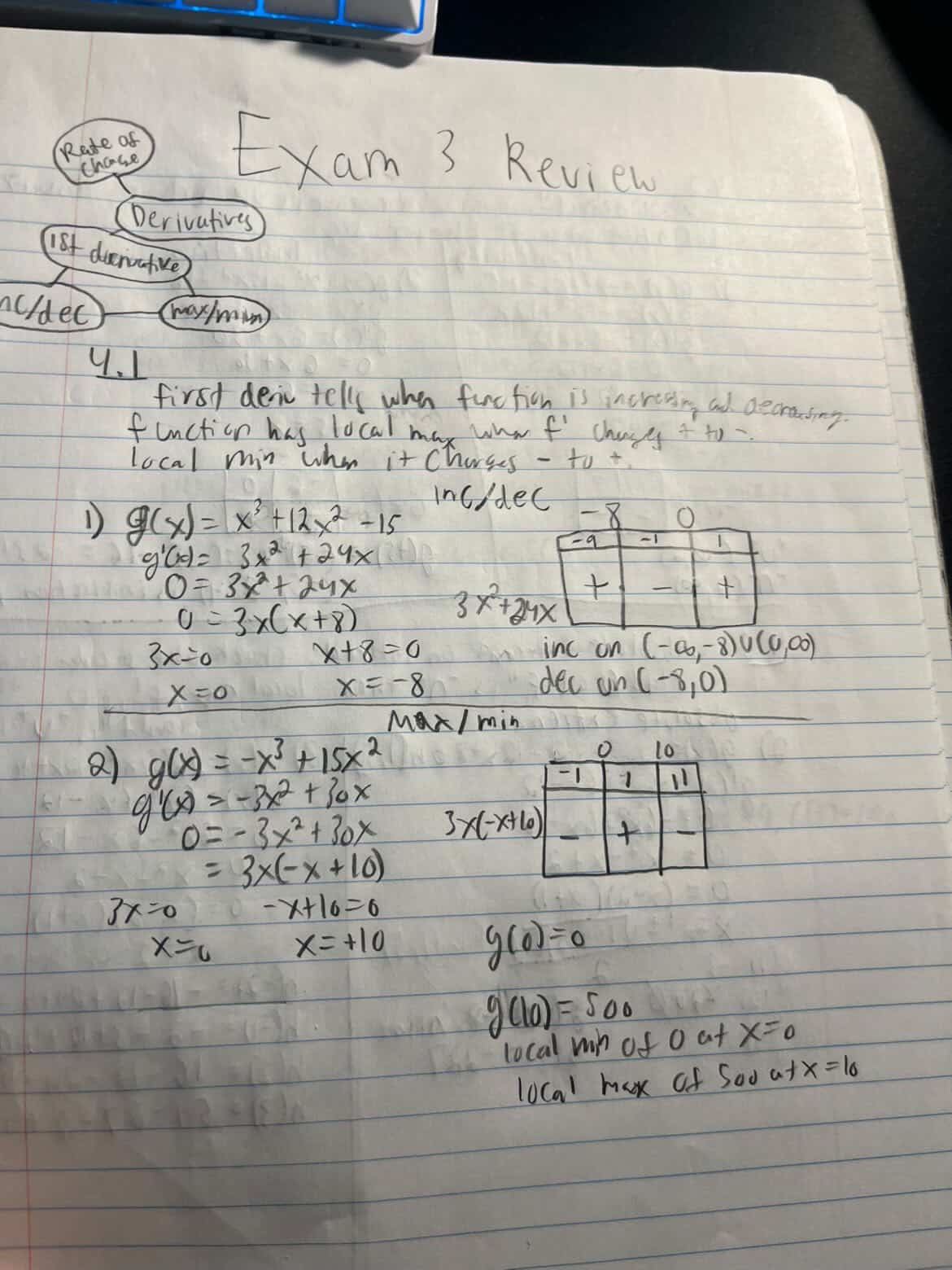
Example 1:
Let's analyze the function to determine where it is increasing or decreasing and to find any local extrema.
Step 1: Find the first derivative.
Step 2: Set the derivative equal to zero to find critical points. ,
Step 3: Test intervals around the critical points. Test intervals: , ,
Step 4: Determine sign of in each interval.
Interval
Test Point
Sign of
+
-
+
Step 5: State intervals of increase/decrease.
Increasing on
Decreasing on
Step 6: Identify local extrema.
Local maximum at (since changes from + to -)
Local minimum at (since changes from - to +)
Example 2:
Now, let's analyze a different function for its critical points and local extrema.
Step 1: Find the first derivative.
Step 2: Set the derivative equal to zero. ,
Step 3: Test intervals around the critical points. Test intervals: , ,
Step 4: Determine sign of in each interval.
Interval
Test Point
Sign of
-
+
-
Step 5: State intervals of increase/decrease.
Increasing on
Decreasing on
Step 6: Identify local extrema.
Local minimum at (since changes from - to +)
Local maximum at (since changes from + to -)
Step 7: Evaluate function at critical points.
Summary Table of Critical Points and Extrema:
Critical Point | Type | Function Value |
|---|---|---|
Local Minimum | $0$ | |
Local Maximum | $500$ |
Key Takeaways
The first derivative test is a powerful tool for analyzing where a function increases or decreases and for locating local maxima and minima.
Always find critical points by setting the first derivative to zero and test intervals between these points to determine the sign of the derivative.
Evaluating the function at critical points helps to classify and quantify local extrema.
