 Back
BackExponential and Logarithmic Functions with Financial Applications
Study Guide - Smart Notes
 Tailored notes based on your materials, expanded with key definitions, examples, and context.
Exponential and Logarithmic Functions
Introduction to Exponential and Logarithmic Functions
Exponential and logarithmic functions are fundamental in business calculus, especially for modeling growth, decay, and financial applications. Exponential functions involve variables in the exponent, while logarithmic functions are their inverses, helping to solve equations where the unknown appears as an exponent.
Exponential Functions
Definition and Properties
An exponential function is a function of the form , where and . The base a is a constant, and the exponent x is a variable.
Base : The number is called Euler's number and is commonly used in continuous growth models.
Exponential Growth and Decay: Exponential functions model processes that increase or decrease at rates proportional to their current value.
Example: is an exponential equation.
Exponential Properties
Product of Powers:
Power of a Power:
Quotient of Powers:
Example:
Logarithmic Functions
Definition and Properties
A logarithmic function is the inverse of an exponential function. The logarithm base a of x is the exponent to which a must be raised to get x:
if and only if
Common Logarithm: is often written as
Natural Logarithm: is written as
Example: because .
Properties of Logarithms
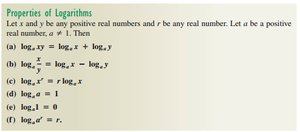
Logarithms have several important properties that simplify calculations and solve equations:
Product Rule:
Quotient Rule:
Power Rule:
Logarithm of 1:
Logarithm of the Base:
Inverse Property:
Examples Using Logarithm Properties
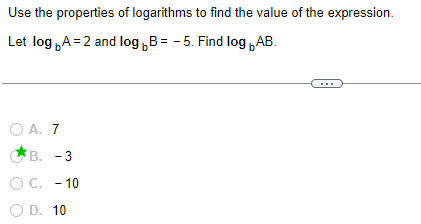
Example 1: , . Find .
Using the product rule: .
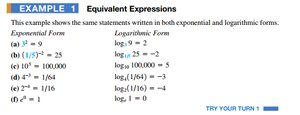
Equivalent Exponential and Logarithmic Forms
Exponential and logarithmic equations can be rewritten in each other's forms:
Exponential:
Logarithmic:
Solving Exponential Equations Using Logarithms
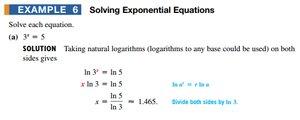
To solve equations where the variable is in the exponent, take the logarithm of both sides:
Example: Solve
Take natural logarithms:
Apply the power rule:
Solve for :
Financial Applications of Exponential and Logarithmic Functions
Simple Interest
Simple interest is calculated using the formula:
Where is interest, is principal, is annual interest rate, and is time in years.
Compound Interest
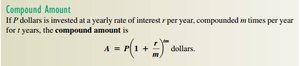
Compound interest is calculated when interest is added to the principal at regular intervals. The formula is:
Where is the amount, is the principal, is the annual interest rate, is the number of compounding periods per year, and is the number of years.
Continuous Compounding
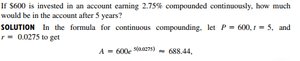
When interest is compounded continuously, the formula becomes:
Where is the amount, is the principal, is the annual interest rate, and is the time in years.
Example: If $600 is invested at 2.75% interest compounded continuously for 5 years:
Change-of-Base Theorem
Logarithmic Change-of-Base
The change-of-base theorem allows you to rewrite logarithms in terms of logarithms with a different base:
This is useful for evaluating logarithms on calculators that only compute or .
Exponential Change-of-Base
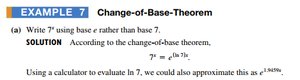
Exponential expressions can also be rewritten using a different base:
This is particularly useful for calculus and continuous growth models.
Tables of Logarithms and Exponentials
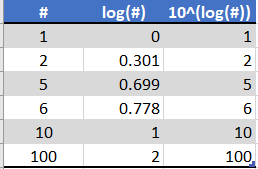
Common Logarithms Table
This table shows the relationship between numbers, their common logarithms, and the result of raising 10 to the logarithm:
# | log(#) | 10^(log(#)) |
|---|---|---|
1 | 0 | 1 |
2 | 0.301 | 2 |
5 | 0.699 | 5 |
6 | 0.778 | 6 |
10 | 1 | 10 |
100 | 2 | 100 |
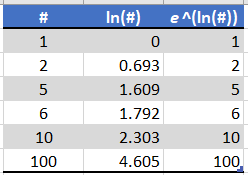
Natural Logarithms Table
This table shows the relationship between numbers, their natural logarithms, and the result of raising to the logarithm:
# | ln(#) | e^(ln(#)) |
|---|---|---|
1 | 0 | 1 |
2 | 0.693 | 2 |
5 | 1.609 | 5 |
6 | 1.792 | 6 |
10 | 2.303 | 10 |
100 | 4.605 | 100 |
Summary Table: Properties of Logarithms
Property | Formula |
|---|---|
Product | |
Quotient | |
Power | |
Logarithm of 1 | |
Logarithm of the Base | |
Inverse |
Practice Problems and Applications
Convert between exponential and logarithmic forms.
Use logarithm properties to simplify expressions and solve equations.
Apply exponential and logarithmic functions to financial problems, such as compound and continuous interest.
