 Back
BackFunctions, Domains, and Graphs: Foundations for Business Calculus
Study Guide - Smart Notes
 Tailored notes based on your materials, expanded with key definitions, examples, and context.
Interval Notation and Inequalities
Definition and Types of Intervals
Interval notation is a concise way to describe sets of real numbers, often used to specify domains of functions. Intervals can be finite or infinite, and may include or exclude endpoints depending on the type of inequality.
Open Interval: (excludes endpoints)
Closed Interval: (includes endpoints)
Half-Open Intervals:
(includes left endpoint)
(includes right endpoint)
Infinite Intervals:
Entire Real Line:
Examples and Applications
Domain of :
Domain of :
Domain of :
Domain of :
Domain of :
Domain of :
Function Domains in Applications
Box Construction Problem
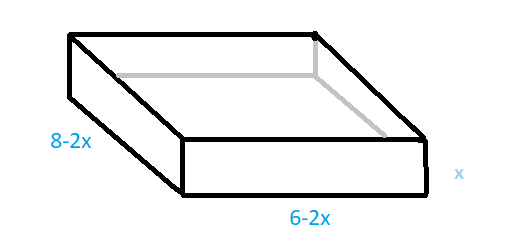
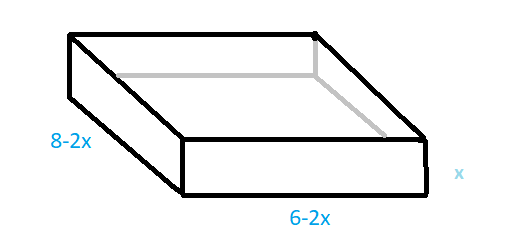
In applied calculus, domains are often restricted by physical constraints. Consider constructing a box from a 6 × 8 piece of cardboard by cutting equal squares from each corner and folding up the sides.
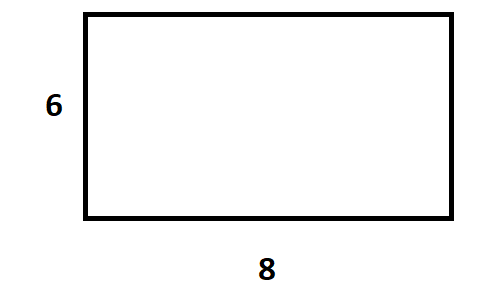
The process involves:
Cutting squares of size x from each corner.
Folding up the sides to form a box.
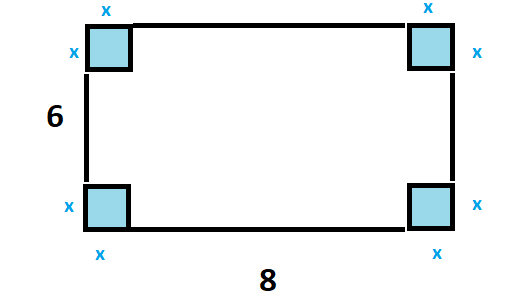
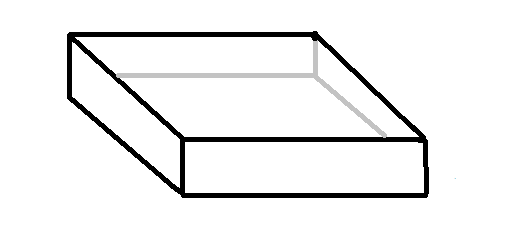
The dimensions of the resulting box are:
Height: x
Length: 8 - 2x
Width: 6 - 2x
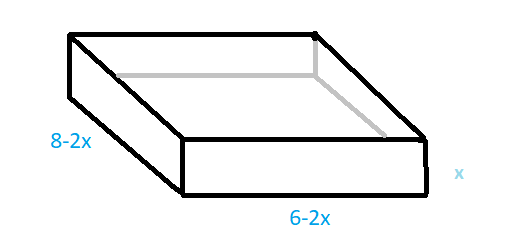
Volume Function
The volume as a function of x is:
Expanded:
Domain of the Volume Function
Although is defined for all real numbers, physical constraints restrict the domain:
(height cannot be negative)
Thus, the domain is
Optimization: Calculus can be used to find the value of x that maximizes the volume, a classic optimization problem.
Review of Basic Functions and Graphs
Constant Functions
A constant function has the form , where is a fixed real number. Its graph is a horizontal line.
Example:
Linear Functions
Linear functions are of the form , where is the slope and is the y-intercept.
Graph: Straight line; slope determines direction (positive or negative).
Y-intercept:
Piecewise Defined Functions
Piecewise functions have different rules for different parts of their domain.
Example:
Graph may have 'breaks' or 'jumps' at points where the rule changes.
Open and closed circles indicate whether endpoints are included.
Absolute Value Function
The absolute value function is piecewise defined:
Graph is V-shaped, meeting at the origin.
Quadratic Functions
Quadratic functions have the form , . Their graphs are parabolas.
Orientation: Upward if , downward if .
Axis of symmetry: , where
Vertex: , where
Roots: Found using the quadratic formula:
Root classification:
No roots if
One (repeated) root if
Two distinct roots if
Polynomials in General
Polynomials of degree () have more complex behavior than quadratics. Their general form is:
Roots are generally harder to find.
Graphs may have multiple peaks and valleys (local maxima and minima).
Calculus (tangent lines, derivatives) helps locate these features.
Summary Table: Interval Notation Types
Interval Notation | Inequality | Includes Endpoints? |
|---|---|---|
(a, b) | a < x < b | No |
[a, b] | a ≤ x ≤ b | Yes |
[a, b) | a ≤ x < b | Left only |
(a, b] | a < x ≤ b | Right only |
(b, ∞) | x > b | No |
[b, ∞) | x ≥ b | Left only |
(−∞, a) | x < a | No |
(−∞, a] | x ≤ a | Right only |
