 Back
BackGuided Practice: Infinite Limits and Limits at Infinity Using Graphs
Study Guide - Smart Notes
 Tailored notes based on your materials, expanded with key definitions, examples, and context.
Q1. Use the graph of shown to find the indicated limits.
Background
Topic: Infinite Limits and Limits at Infinity
This question tests your understanding of how to evaluate limits using the graph of a function, especially when the limits approach infinity or negative infinity, or when the function approaches a vertical or horizontal asymptote.
Key Terms and Formulas
Limit: The value that approaches as approaches a certain value.
Infinite Limit: When increases or decreases without bound as approaches a certain value.
Vertical Asymptote: A line where increases or decreases without bound as approaches .
Horizontal Asymptote: A line where approaches as approaches infinity or negative infinity.
Step-by-Step Guidance
Carefully examine the graph of provided. Identify any vertical or horizontal asymptotes, as these often indicate where limits may approach infinity or a constant value.
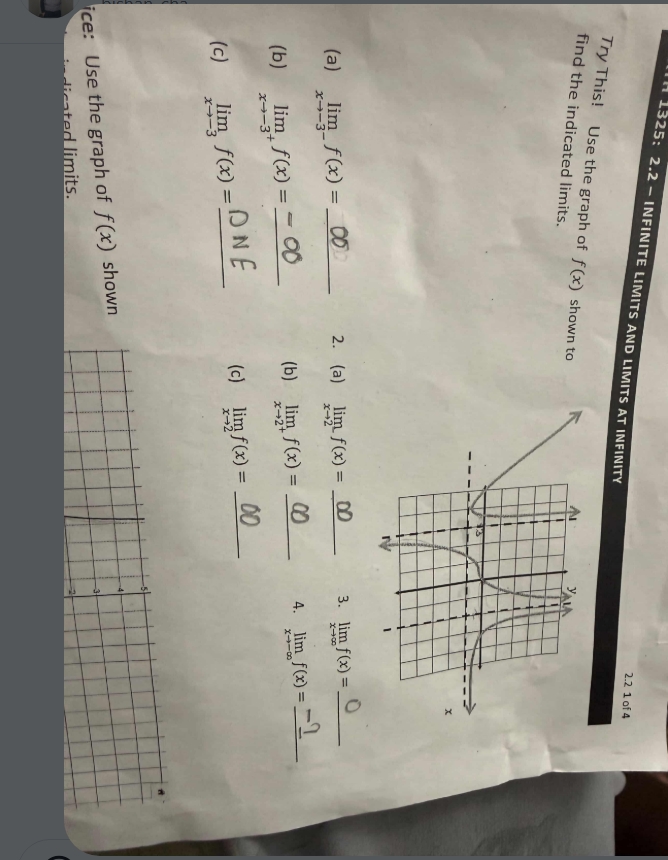
For each limit, determine the direction from which is approaching (from the left, right, or both sides) and observe the behavior of as gets close to the specified value.
For limits as approaches a finite value (e.g., or ), check if the function goes to infinity, negative infinity, or a finite value. If the function goes up or down without bound, the limit is infinite (positive or negative).
For limits as approaches infinity or negative infinity, look for horizontal asymptotes or the end behavior of the graph. What value does approach as gets very large or very small?
Write the limit notation for each part and use the graph to estimate the value or determine if the limit is infinite.
Try solving on your own before revealing the answer!
