 Back
BackHigher Derivatives, Concavity, and the Second Derivative Test
Study Guide - Smart Notes
 Tailored notes based on your materials, expanded with key definitions, examples, and context.
Higher Derivatives
Definition and Notation
Higher derivatives are obtained by repeatedly differentiating a function. The first derivative, f'(x), gives the rate of change of the function. The second derivative, f''(x), describes the rate of change of the first derivative, and so on. For derivatives beyond the third, we use notation such as f^{(n)}(x) for the nth derivative.
First derivative:
Second derivative:
Third derivative:
n-th derivative:
Example: If , then:
Leibniz Notation: The second derivative can also be written as .
Example: Find :
First derivative:
Second derivative:
Example: Find the second and third derivatives:
For :
First derivative:
Second derivative:
Third derivative:
For , use the quotient rule for derivatives.
For :
All derivatives: for any
Concavity and the Second Derivative
Definition of Concavity
Concavity describes the direction in which a function curves. It is determined by the sign of the second derivative:
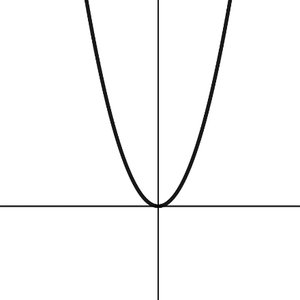
Concave up on interval if for all in $I$ (the graph opens upward).
Concave down on interval if for all in $I$ (the graph opens downward).
Example: The graph below is concave up on :
Example: The graph below is concave down on :
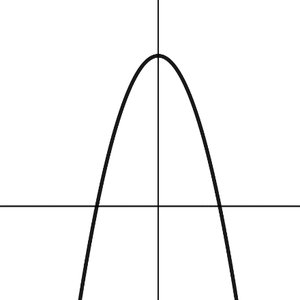
As you move from left to right, if the slopes of the tangent lines increase, the function is concave up. If the slopes decrease, the function is concave down.
The Second Derivative Test for Relative Extrema
Test and Application
The Second Derivative Test helps classify critical points (where ) as relative minima or maxima:
If , then is a relative minimum.
If , then is a relative maximum.
If , the test is inconclusive; use the First Derivative Test instead.
Example: For , find and classify all relative extrema using the Second Derivative Test.
Find and solve for critical points.
Evaluate at each critical point to classify as minimum or maximum.
Points of Inflection
Definition and Identification
A point of inflection is where the concavity of a function changes from up to down or vice versa. For to be a point of inflection:
or does not exist
Concavity must actually change at
Example: For , determine intervals of concavity and find inflection points:
Find and solve for candidates.
Test intervals around each candidate to confirm a change in concavity.
Applications: Velocity and Acceleration
Definitions
Velocity: , the rate of change of position with respect to time.
Acceleration: , the rate of change of velocity with respect to time.
Interpretation:
If velocity is positive, the object moves away from the starting point.
If velocity is negative, the object moves toward the starting point.
If acceleration is positive, the object is speeding up.
If acceleration is negative, the object is slowing down.
Example: For :
Velocity:
Acceleration:
Maximum height occurs when ; solve for .
