 Back
BackImplicit Differentiation- Chapter 3
Study Guide - Smart Notes
 Tailored notes based on your materials, expanded with key definitions, examples, and context.
Additional Derivative Topics
Implicit Differentiation
Implicit differentiation is a technique used to find derivatives when the relationship between variables is given implicitly, rather than explicitly. This method is especially useful for equations that are difficult or impossible to solve for one variable in terms of another.
Explicit Equation: An equation where the dependent variable is isolated, e.g., .
Implicit Equation: An equation where the dependent and independent variables are mixed, e.g., .
Implicit Differentiation Process: Differentiate both sides of the equation with respect to the independent variable, treating the dependent variable as a function of the independent variable.
Key Formula: If is a function of , then when differentiating $y$ with respect to $x$, use .
Example: For the equation , differentiate both sides with respect to :
Solving for :
Application: Implicit differentiation allows us to find slopes of tangent lines to curves defined implicitly, such as circles or other non-function graphs.
Special Function Notation
Special function notation is used to minimize symbols and clarify the relationship between variables. Functions can involve one or more independent variables.
Single Variable Function: , where is dependent and is independent.
Multivariable Function: , where depends on both and .
Notation: Using as both a dependent variable and a function symbol simplifies expressions.
Example: defines a function with two independent variables.
Explicit vs. Implicit Relationships
Understanding the difference between explicit and implicit relationships is crucial for applying the correct differentiation technique.
Explicit: , the relationship is directly stated.
Implicit: , the relationship is implied and not directly stated.
Both forms can define the same function, but require different approaches for differentiation.
Why Use Implicit Differentiation?
Implicit differentiation is necessary when equations cannot be easily solved for one variable. It provides a consistent method for finding derivatives in complex cases.
Many equations are difficult or impossible to solve explicitly for in terms of .
Implicit differentiation allows us to find even when is not isolated.
Examples of Implicit Differentiation
Example 1: Circle Equation
Given :
Differentiate implicitly:
Solve for :
At , or (since )
Slopes at and : and
Graph: The equation represents a circle with center at and radius $5x = 3$, there are two points and two tangent lines with different slopes.
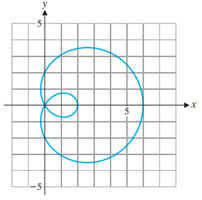
Example 2: Tangent Lines to Implicit Curve
Given an equation with two points at , e.g., and :
Find values for .
Differentiate implicitly to find .
Use point-slope form to write equations of tangent lines at each point.
Example 3: Implicit Differentiation with Different Variables
Given defined implicitly by an equation involving :
Differentiate both sides with respect to .
Find and evaluate at specific values, e.g., , .
Explore and Discuss: Multiple Tangent Lines
Some implicit equations, such as circles, can have multiple tangent lines at a given value. For example, at on a circle, there are tangent lines with both positive and negative slopes. This is because the graph is not a function (fails the vertical line test), so multiple values exist for a single $x$.
Reason: The graph is not a function because for some values, there are multiple values.
Implication: Multiple tangent lines can exist at the same value.
Summary Table: Explicit vs. Implicit Differentiation
Type | Equation Form | Differentiation Method | Example |
|---|---|---|---|
Explicit | Direct differentiation | ||
Implicit | Implicit differentiation |
