 Back
BackIncreasing and Decreasing Functions: Critical Numbers and Intervals
Study Guide - Smart Notes
 Tailored notes based on your materials, expanded with key definitions, examples, and context.
Section 5.1: Increasing and Decreasing Functions
Introduction
This section explores how to determine where a function is increasing or decreasing, and introduces the concept of critical numbers. These ideas are foundational for analyzing the behavior of functions, especially in business calculus where optimization and trend analysis are essential.
Definitions
Increasing Function: A function f is increasing over an interval I if, for every a and b in I, if a < b, then f(a) < f(b).
Decreasing Function: A function f is decreasing over an interval I if, for every a and b in I, if a < b, then f(a) > f(b).
Examples:
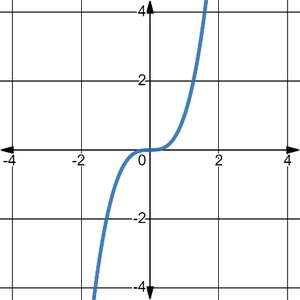
Increasing on : The function is always rising as x increases.
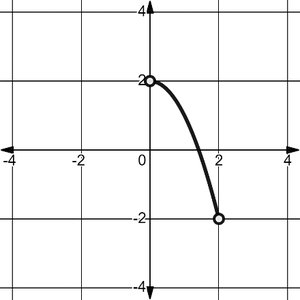
Decreasing on : The function falls as x increases from 0 to 2.
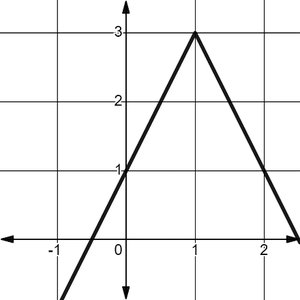
Increasing on , Decreasing on : The function rises until x = 1, then falls.
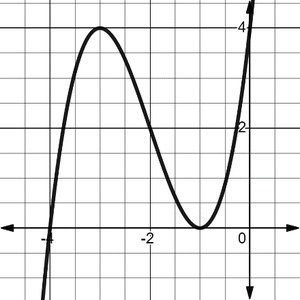
Increasing on , Decreasing on : The function rises, falls, then rises again.
Critical Numbers and Critical Points
Changes from increasing to decreasing (or vice versa) often occur at special points:
Where the tangent line is horizontal (derivative is zero)
Where there is a sharp point (derivative does not exist)
Definition: A critical number (or critical value) of a function f is any number c in the domain of f for which or does not exist. The point is called a critical point.
Example: Find all critical numbers for .
Compute the derivative:
Set :
There are no points where does not exist (since it is a polynomial).
Critical number:
Test for Intervals of Increase and Decrease
To determine where a function is increasing or decreasing, use the sign of the derivative:
If for each in an interval, is increasing on that interval.
If for each in an interval, is decreasing on that interval.
If for each in an interval, is constant on that interval.
Procedure for Finding Intervals of Increase and Decrease
Determine the domain of . (For polynomials, the domain is .)
Find .
Find all critical numbers by solving and where does not exist.
Make a sign diagram for the first derivative:
Draw a number line for the domain of .
Mark each critical number on the number line.
Choose a test value in each subinterval created by the critical numbers.
Calculate for each test value. If , is increasing on that subinterval; if , $f$ is decreasing.
Example 1:
Find
Set :
Test intervals: , ,
Choose test points and evaluate to determine sign and thus intervals of increase/decrease.
Example 2:
Find
Set and solve for (may require factoring or numerical methods).
Test intervals between critical numbers as above.
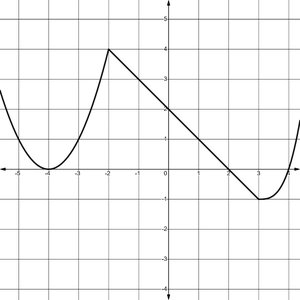
Analyzing the Graph of the Derivative
Sometimes, you are given the graph of (the derivative) and asked about the behavior of :
Critical values: Occur where (crosses the x-axis) or is undefined.
Increasing intervals: Where (above the x-axis).
Decreasing intervals: Where (below the x-axis).
Summary Table: Increasing, Decreasing, and Critical Points
Interval | Sign of | Behavior of |
|---|---|---|
Increasing | ||
Decreasing | ||
At | or DNE | Critical Point |
Additional info: In business calculus, identifying intervals of increase and decrease helps in maximizing profit, minimizing cost, and understanding trends in economic models.
