 Back
BackIntegration and Its Applications in Business Calculus
Study Guide - Smart Notes
 Tailored notes based on your materials, expanded with key definitions, examples, and context.
Chapter 5 - Integration
5.1 Antiderivatives & Indefinite Integrals
Antiderivatives are the reverse operation of differentiation. If a function F(x) has a derivative equal to f(x), then F(x) is called an antiderivative of f(x). The collection of all antiderivatives of a function is called the indefinite integral.
Definition: If F'(x) = f(x), then F(x) is an antiderivative of f(x).
Notation: The indefinite integral is written as , where C is the constant of integration.
Key Properties:
, for
Example: Find an antiderivative for . One possible answer is .
5.2 Integration by Substitution
Integration by substitution is a technique used to evaluate more complex integrals, essentially reversing the chain rule. If , then .
Steps:
Choose a substitution that simplifies the integral.
Compute .
Rewrite the integral in terms of and .
Integrate with respect to .
Substitute back in terms of .
Example: . Let , then .
5.4 The Definite Integral
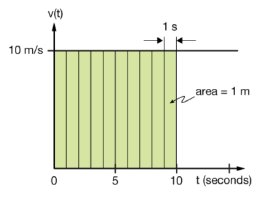
The definite integral computes the net area under a curve between two points. It is closely related to the concept of area and displacement in applications.
Definition: is the definite integral of f(x) from a to b.
Interpretation: The definite integral represents the signed area between the curve and the x-axis from x = a to x = b.
Properties:
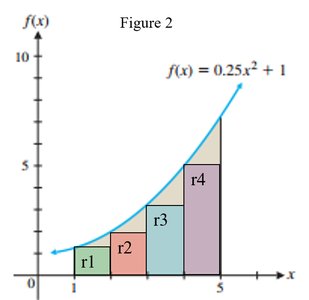
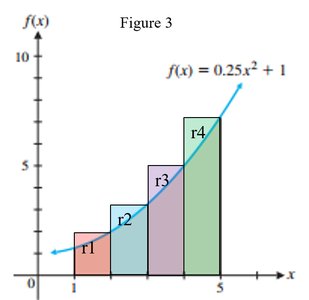
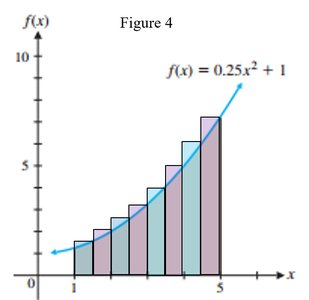
Riemann Sums: Approximates the area under a curve by summing areas of rectangles. As the number of rectangles increases, the approximation improves.
Left rectangles: Use the left endpoint for the height.
Right rectangles: Use the right endpoint for the height.
5.5 The Fundamental Theorem of Calculus
The Fundamental Theorem of Calculus connects differentiation and integration. It states that if F is any antiderivative of f on [a, b], then:
This theorem allows us to evaluate definite integrals using antiderivatives.
Example: To evaluate , find an antiderivative and compute the difference at the endpoints.
Chapter 6 - Additional Integration Topics
6.1/6.2 Area Between Curves & Integration Applications
Area Between Curves
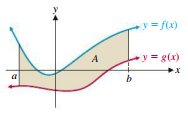
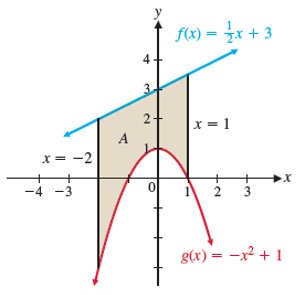
The area between two curves and from to is given by:
, where on [a, b].
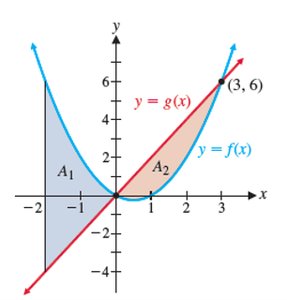
Signed area: Area above the x-axis minus area below the x-axis.
Unsigned area: Always nonnegative, representing the total region between curves.
Applications in Business & Economics
Integration is used to analyze income distribution, continuous income streams, and consumer/producer surplus.
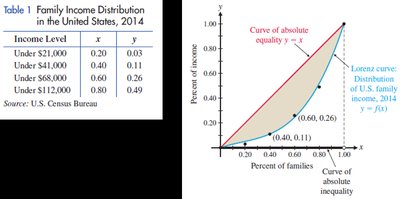
Lorenz Curve: Graphs cumulative income distribution. The Gini Index measures income inequality as .
Continuous Income Stream: Total income over [a, b] is .
Future Value: For continuous compounding at rate r, .
Consumer Surplus:
Producer Surplus:
Probability Density Functions
A probability density function (pdf) f(x) for a continuous random variable must satisfy:
f(x) ≥ 0 for all x
The total area under f(x) over all real numbers is 1
The probability that x is in [c, d] is
Summary Table: Properties of Definite Integrals
Property | Formula |
|---|---|
Zero interval | |
Reversal of limits | |
Constant multiple | |
Sum/Difference | |
Additivity |
