 Back
BackIntegration and Its Applications in Business Calculus
Study Guide - Smart Notes
 Tailored notes based on your materials, expanded with key definitions, examples, and context.
Chapter 5 - Integration
5.1 Antiderivatives & Indefinite Integrals
Antiderivatives are the reverse operation of differentiation. If a function F(x) has a derivative equal to f(x), then F(x) is called an antiderivative of f(x). The collection of all antiderivatives of a function is called the indefinite integral.
Definition: If F'(x) = f(x), then F(x) is an antiderivative of f(x).
Notation: The indefinite integral is written as , where C is the constant of integration.
Key Properties:
, for
Example: Find . The answer is .
5.2 Integration by Substitution
Integration by substitution is a method used to evaluate more complex integrals, essentially applying the chain rule in reverse. If , then .
Steps:
Choose a substitution that simplifies the integral.
Compute .
Rewrite the integral in terms of and .
Integrate with respect to .
Substitute back in terms of .
Example: . Let , then . The integral becomes .
5.4 The Definite Integral
Area Under a Curve and Riemann Sums
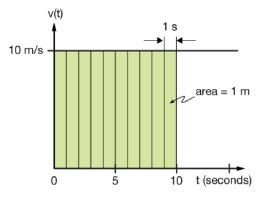
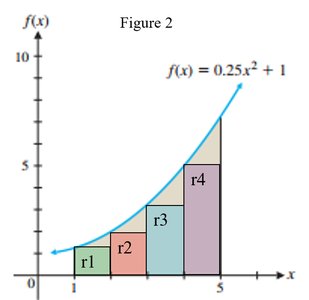
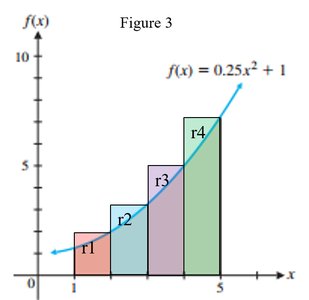
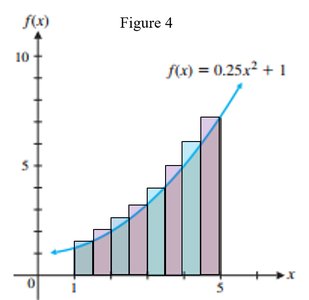
The definite integral of a function over an interval [a, b] gives the net area under the curve between those points. For constant functions, this area is a rectangle; for more complex functions, we approximate the area using rectangles (Riemann sums).
Left and Right Rectangles: The height of each rectangle is determined by the function value at the left or right endpoint of each subinterval.
Riemann Sum: , where and is a sample point in each subinterval.
Definite Integral as a Limit:
Properties of Definite Integrals
for
5.5 The Fundamental Theorem of Calculus
The Fundamental Theorem of Calculus connects differentiation and integration. If F is any antiderivative of f, then:
Any antiderivative can be used, but the constant of integration cancels out.
Example: can be evaluated by finding an antiderivative and computing the difference at the endpoints.
Chapter 6 - Additional Integration Topics
6.1/6.2 Area Between Curves & Applications
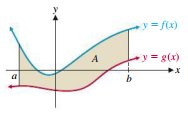
Area Between Curves
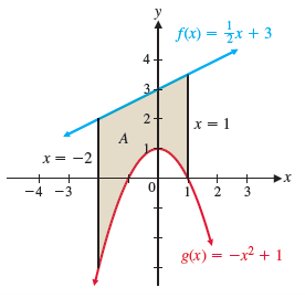
The area between two curves and from to is given by:
, where on .
Signed Area: Area above the x-axis minus area below the x-axis.
Applications: Income Distribution and the Lorenz Curve
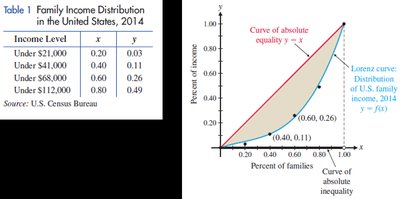
The Lorenz curve is used to represent income distribution. The Gini index measures income inequality and is calculated as:
A Gini Index of 0 means perfect equality; 1 means perfect inequality.
Area Between More Complex Curves
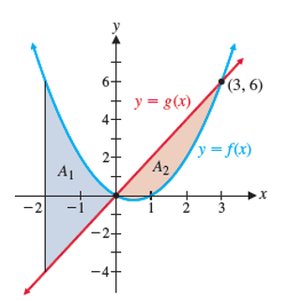
For functions that cross, the area between them may need to be split at intersection points. The unsigned area is always nonnegative.
Probability Density Functions
A probability density function (pdf) describes the likelihood of a continuous random variable falling within a certain interval. The total area under the pdf over its domain is 1, and the probability that the variable falls between c and d is .
Conditions for a pdf:
for all x
Probability on is
Consumers' and Producers' Surplus
These concepts measure the benefit to consumers and producers in a market at equilibrium price and quantity .
Consumers' Surplus:
Producers' Surplus:
