 Back
BackIntegration: Antiderivatives and Indefinite Integrals
Study Guide - Smart Notes
 Tailored notes based on your materials, expanded with key definitions, examples, and context.
Chapter 5: Integration
Antiderivatives and Indefinite Integrals
Integration is a fundamental concept in calculus, closely related to differentiation. The process of finding an antiderivative, or indefinite integral, allows us to recover a function from its derivative. This section introduces the concept of antiderivatives, their properties, and applications in business contexts.
Antiderivatives
Definition: A function F is an antiderivative of a function f if .
Family of Functions: Antidifferentiation does not yield a unique function, but an entire family of functions differing by a constant.
Theorem: If the derivatives of two functions are equal on an open interval , then the functions differ by at most a constant. Symbolically, if for all in , then for some constant .
Example: A Family of Antiderivatives
Problem: Find all antiderivatives of .
Solution: The general antiderivative is , where is any constant.
Graphical Interpretation: The graphs of these antiderivatives are vertical translations of each other, passing through points such as (0,0), (0,1), and (0,2).
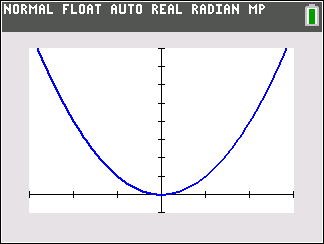
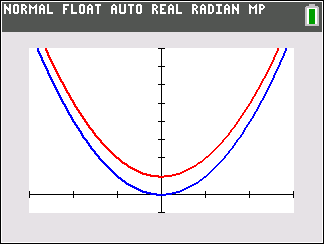
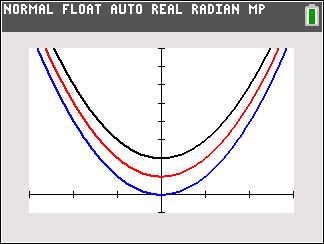
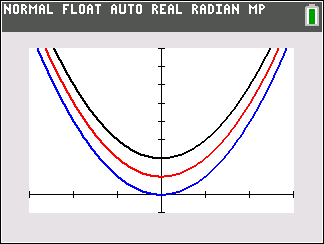
Relationship: As shown in the graphs, the three antiderivatives are vertical translations of each other.
Indefinite Integrals: Formulas and Properties
Notation: The indefinite integral of with respect to is written as .
Constant of Integration: The arbitrary constant is called the constant of integration.
Reverse Operations: Indefinite integration and differentiation are reverse operations, except for the addition of the constant of integration. Symbolically, and .
Formulas: Indefinite Integrals of Basic Functions
Power Rule: , for
Exponential Rule:
Constant Rule:
Sum Rule:
Properties: Indefinite Integrals
Linearity:
Integration is the reverse of differentiation:
Examples Using Indefinite Integral Properties and Formulas
Example: Integrate .
Solution:
Applications of Antiderivatives
Particular Antiderivative: Find the equation of the curve that passes through (3, 5) if the slope of the curve is given by at any point .
Solution: Integrate to get . Use the point (3,5) to solve for : . Thus, .
Cost Function Example: If the marginal cost is with fixed costs of , find and the cost of producing 30 units.
Solution: Integrate : . Use to find . Thus, . For , .
Advertising Example: A radio station wants to increase listeners from 27,000 to 41,000. The campaign should last about 40 more days, based on the integration of the growth rate function.
Summary Table: Indefinite Integral Rules
Function | Indefinite Integral |
|---|---|
Additional info: The examples and applications provided are typical in business calculus, illustrating how integration is used to solve real-world problems such as cost analysis and growth modeling.
