 Back
BackLimits and One-Sided Limits in Calculus
Study Guide - Smart Notes
 Tailored notes based on your materials, expanded with key definitions, examples, and context.
Limits and One-Sided Limits
Definition of a Limit
The concept of a limit is fundamental in calculus and describes the behavior of a function as the input approaches a particular value. Formally, the limit of a function f(x) as x approaches a is written as:
Limit Notation:
This means that as x gets arbitrarily close to a (from either side), the values of f(x) approach L.
Example: means as x approaches 4, f(x) approaches 3.
One-Sided Limits
Sometimes, it is useful to consider the behavior of a function as x approaches a value from only one side:
Left-Hand Limit: (as x approaches a from the left)
Right-Hand Limit: (as x approaches a from the right)
Key Point: The two-sided limit exists only if both one-sided limits exist and are equal:
If , then .
If the one-sided limits are not equal, the two-sided limit does not exist at that point.
Examples with Quadratic Function
Consider the function :
From the left:
From the right:
From both sides:
This shows that the limit exists and equals 4 as x approaches 2.
Evaluating Limits from a Graph
To find limits using a graph, observe the value that f(x) approaches as x gets close to a specific point from the left and right. The actual value of f(x) at that point (if defined) is not always the same as the limit.
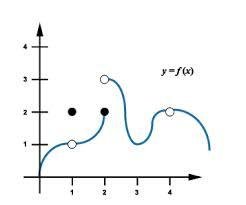
Example Analysis from the Graph:
At x = 2:
Left-hand limit: Value f(x) approaches as x approaches 2 from the left.
Right-hand limit: Value f(x) approaches as x approaches 2 from the right.
If both are equal, the two-sided limit exists.
The filled or open circles indicate whether f(2) is defined and what its value is.
At x = 4:
Repeat the process for left and right limits.
Compare with the actual value f(4) if defined.
Important: The limit as x approaches a value depends on the behavior near that value, not necessarily the function's value at that point.
Summary Table: Limits and Function Values
x-value | Left-Hand Limit | Right-Hand Limit | Two-Sided Limit | Function Value |
|---|---|---|---|---|
2 | Value from left | Value from right | Exists if left = right | f(2) (may differ) |
4 | Value from left | Value from right | Exists if left = right | f(4) (may differ) |
Additional info: The table summarizes how to compare one-sided limits, two-sided limits, and function values at specific points using a graph.
