 Back
BackLimits and the Derivative: Average and Instantaneous Rates of Change
Study Guide - Smart Notes
 Tailored notes based on your materials, expanded with key definitions, examples, and context.
Limits and the Derivative
Introduction to Derivatives
The concept of limits is fundamental in calculus and helps solve two basic problems: finding the equation of the tangent line to a function at a specified point, and determining the instantaneous velocity of an object in motion. These problems are central to understanding how functions change and are applied in business, economics, and the sciences.
Tangent Line: The tangent line represents the instantaneous direction of a function at a specific point.
Instantaneous Velocity: The velocity at a specific moment, as opposed to the average velocity over an interval.
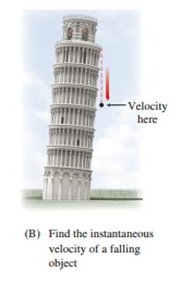
Average Rate of Change
The average rate of change of a function measures how much the function's output changes per unit change in input over a specified interval. In business applications, this often relates to revenue, cost, or profit changes as production levels vary.
Definition: For a function f(x), the average rate of change from x = a to x = a + h is given by:
This formula is known as the difference quotient.
It is used to calculate average velocity, average revenue change, and other rates in applied contexts.
Example: Revenue Analysis
Consider a company manufacturing plastic planter boxes. The revenue function is R(x) = 20x - 0.02x^2 for 0 < x < 1,000. To find the change in revenue when production increases from 100 to 400 planters:
Change in Revenue:
Average Rate of Change:
Revenue increases by an average of $10 per planter.
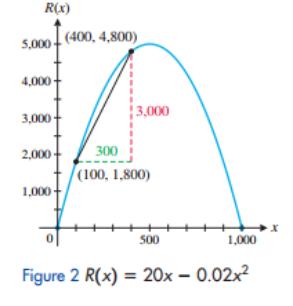
The graph shows the secant line connecting the points (100, 1,800) and (400, 4,800). The slope of this secant line represents the average rate of change in revenue between these points.
Example: Velocity of a Falling Object
For a small steel ball dropped from a tower, the distance fallen in x seconds is given by y = f(x) = 16x^2. The positions at 0, 1, 2, and 3 seconds are illustrated below:
At 1 second: 16 feet
At 2 seconds: 64 feet
At 3 seconds: 144 feet
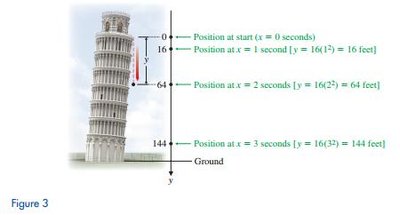
To find the average velocity from x = 2 to x = 3 seconds:
Average Velocity: feet per second
For a general interval from x = 2 to x = 2 + h:
As h approaches zero, the limit gives the instantaneous velocity:
feet per second
Instantaneous Rate of Change
The instantaneous rate of change at a point is the limit of the average rate of change as the interval shrinks to zero. This is the foundation of the derivative.
Definition: For f(x), the instantaneous rate of change at x = a is:
This is also called the derivative at x = a.
In applications, this represents the instantaneous velocity, marginal revenue, or other rates.
Slope of the Tangent Line
The tangent line to a curve at a point represents the instantaneous direction of the curve. The slope of the tangent line is given by the derivative at that point.
Secant Line: A line passing through two points on the curve; its slope is the average rate of change.
Tangent Line: A line passing through one point and representing the instantaneous rate of change.
As the second point on the secant line approaches the first, the secant line becomes the tangent line.
Definition: The Derivative
The derivative of a function f(x) at x = a is defined as:
If this limit exists for all x in an interval, f is said to be differentiable on that interval.
The process of finding the derivative is called differentiation.
Interpretations of the Derivative
The derivative f'(x) has several important interpretations:
Slope of the Tangent Line: f'(x) is the slope of the tangent to the graph at (x, f(x)).
Instantaneous Rate of Change: f'(x) is the instantaneous rate of change of y = f(x) with respect to x.
Velocity: If f(x) is position, f'(x) is velocity.
Procedure: Four-Step Process for Finding the Derivative
To find the derivative of a function f(x):
Find f(x + h).
Compute f(x + h) - f(x).
Divide by h:
Take the limit as h approaches zero:
Example: Finding a Derivative
For f(x) = -16x^2 + 80x + 6, use the four-step process:
Step 1:
Step 2:
Step 3:
Step 4:
Thus, the derivative is f'(x) = -32x + 80.
Nonexistence of the Derivative
The derivative at x = a exists only if the limit defining the derivative exists. If the limit does not exist, the function is nondifferentiable at that point.
Definition: If does not exist, then f is nondifferentiable at x = a.
