 Back
BackMAC2233 Calculus for Business, Social and Life Sciences – Syllabus and Study Guide
Study Guide - Smart Notes
 Tailored notes based on your materials, expanded with key definitions, examples, and context.
Course Overview
MAC2233 Calculus for Business, Social and Life Sciences is a foundational course designed for students in business, economics, social sciences, and life sciences. The course covers essential calculus concepts, including functions, graphs, limits, differentiation, integration, and their applications in real-world contexts. The course is delivered fully online and utilizes MyLab Math for assignments and assessments.

Textbook and Materials
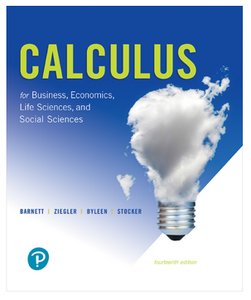
Required Textbook: Calculus for Business, Economics, Life Sciences & Social Sciences, Brief Version, 14th edition by Barnett, Ziegler, Byleen, Stocker (Pearson)
Courseware: MyLab Math Access Code (required for all assignments and assessments)
Calculator: A handheld scientific calculator is optional for proctored exams; an on-screen calculator is available in Honorlock.
Course Structure and Major Topics
The course is organized into four main units, each corresponding to key chapters in business calculus. Below is a structured summary of the main topics and subtopics, with academic context and examples for each.
Unit 1: Functions, Graphs, and Limits
Functions and Graphs
Definition of a Function: A function is a relation that assigns exactly one output value for each input value. Notation: .
Linear Functions: Functions of the form , where is the slope and is the y-intercept.
Quadratic Functions: Functions of the form .
Graphing: Plotting points and analyzing the shape and intercepts of linear and quadratic functions.
Applications: Modeling cost, revenue, and profit in business scenarios.
Example: If represents the cost to produce items, then is a linear function with slope 5 and y-intercept 200.
Limits
Definition of a Limit: The value that a function approaches as the input approaches a certain value.
One-Sided Limits: Limits from the left () and right ().
Limits at Infinity: Behavior of functions as or .
Continuity: A function is continuous at if .
Example: .
Unit 2: The Derivative and Its Applications
Definition and Interpretation of the Derivative
Derivative: Measures the instantaneous rate of change of a function. Notation: or .
Geometric Meaning: The slope of the tangent line to the graph at a point.
Formula:
Applications: Marginal cost, marginal revenue, and marginal profit in business.
Example: If , then represents the marginal cost per item.
Differentiation Rules
Power Rule:
Product Rule:
Quotient Rule:
Chain Rule:
Exponential and Logarithmic Functions: ,
Applications of the Derivative
Marginal Analysis: Using derivatives to estimate changes in cost, revenue, and profit for small changes in quantity.
Optimization: Finding maximum or minimum values of functions, such as maximizing profit or minimizing cost.
Elasticity of Demand: , measures responsiveness of quantity demanded to price changes.
Unit 3: Graphing and Optimization
Graphing with Derivatives
First Derivative Test: Determines intervals where a function is increasing or decreasing.
Second Derivative Test: Determines concavity and points of inflection.
Critical Points: Where or is undefined; candidates for local maxima or minima.
Absolute Maxima and Minima: Highest and lowest values on a closed interval.
Asymptotes: Vertical and horizontal lines that the graph approaches but never touches.
Example: For , , set to find critical points.
Optimization in Business
Setting up Optimization Problems: Define the objective function (e.g., profit, cost) and constraints.
Solving: Take the derivative, set it to zero, and solve for critical points. Use the second derivative or endpoints to determine maxima/minima.
Applications: Maximizing profit, minimizing cost, optimizing resource allocation.
Unit 4: Integration and Its Applications
Antiderivatives and Indefinite Integrals
Antiderivative: A function such that .
Indefinite Integral: , where is the constant of integration.
Basic Rules: (for )
Integration by Substitution: Used for composite functions; let , then .
Definite Integrals and the Fundamental Theorem of Calculus
Definite Integral: gives the net area under the curve from to .
Fundamental Theorem of Calculus: If is an antiderivative of , then .
Applications of Integration
Area Between Curves: gives the area between and from to .
Business Applications: Calculating consumer and producer surplus, total cost and revenue from marginal functions, present and future value in finance.
Example: If marginal cost , then total cost for producing items is .
Assessment and Grading
Assessment | Weight |
|---|---|
Homework (MyLab Math) | 15% |
Quizzes (MyLab Math) | 15% |
Tests (4 total, proctored) | 50% |
Final Exam (proctored) | 20% |
Practice Tests (extra credit) | Up to 3% |
Academic Integrity and Technology Requirements
Honorlock: All tests and the final exam are proctored online using Honorlock. A webcam, microphone, and Google Chrome browser are required.
Academic Honesty: All work must be your own. Cheating, plagiarism, and unauthorized collaboration are strictly prohibited and subject to disciplinary action.
Technology: Reliable internet, a computer with updated software, and access to Microsoft Office 365 are required.
Student Support and Resources
Math Lab (Academic Success Center): Offers tutoring, study groups, and technology support.
Brainfuse: 24/7 online tutoring available for all students.
Mental Health Services: Confidential counseling and support are available at no cost to students.
Course Schedule and Deadlines
The course follows a weekly schedule with specific deadlines for each module, quiz, test, and the final exam. Students are responsible for keeping track of all due dates and completing assignments on time.
Summary Table: Major Topics and Chapters
Unit | Main Topics | Textbook Chapters |
|---|---|---|
1 | Functions, Graphs, Limits | Ch. 1, Ch. 2 |
2 | Derivatives and Applications | Ch. 2, Ch. 3 |
3 | Graphing and Optimization | Ch. 4 |
4 | Integration and Applications | Ch. 5, Ch. 6 |
Additional info: For more detailed examples, practice problems, and instructional videos, refer to the MyLab Math platform and the assigned textbook sections for each module.
