 Back
Simple Interest and Discount Notes in Business Mathematics
Study Guide - Smart Notes
 Tailored notes based on your materials, expanded with key definitions, examples, and context.
Simple Interest Notes
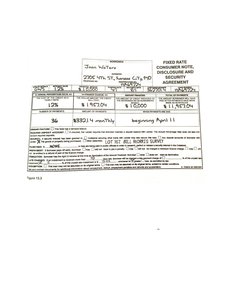
Promissory Notes
A promissory note is a formal written agreement in which a borrower commits to repay a lender a specified sum of money, usually with interest, by a certain date. This document is commonly used in business transactions and must include key information such as the date, loan term, lender's name, principal amount, interest rate, payment entity, due date, and the borrower's signature.
Lender: The person or entity providing the loan.
Beneficiary: The person receiving the loan.
Principal (P): The original amount borrowed.
Interest Rate (R): The percentage charged for borrowing.
Term (T): The length of time for repayment, often in months or days.
Due Date: The date by which the loan must be repaid.
Example: Fred Romero borrows $15,000 for 10 months at an interest rate of 11.5% (0.115). The promissory note is signed on April 30. The due date is calculated as 10 months after April 30, which is February 28 (since February has only 28 days).
Simple Interest Formula
The simple interest formula calculates the interest earned or paid on a principal over a period of time:
Where I is the interest, P is the principal, R is the interest rate (as a decimal), and T is the time in years.
The future value (amount to be repaid) is:
Or
Example Calculation:
Principal: $15,000
Rate: 11.5% = 0.115
Time: 10 months = years
Interest:
Future Value:
Finding Principal and Interest
To find the principal when the future value is known:
Rearrange:
Example: Sheila Walker signs a 120-day note at 9% for $7,725. Find the principal and interest.
Time: years
Principal:
Interest:
Finding the Due Date
To determine the due date for a promissory note based on days:
Locate the starting date in a calendar or table and count the days up to that date.
Add the loan term (in days) to the starting date.
Find the resulting date in the table to identify the due date.
Example: If the note is dated March 12 and the term is 150 days, add 71 days (up to March 12) + 150 days = 221 days. Locate 221 days in the table to find the due date.
Simple Discount Notes
Definition and Formula
A simple discount note is a promissory note where the interest is deducted from the future value at the time the note is issued. The discount is calculated using:
Where B is the bank interest discount, M is the future value, D is the discount rate (as a decimal), and T is the time in years.
The principal (amount received) is:
Example: Marie Gostowski takes a $12,000 loan for 10 months at a 9% discount rate.
Time: years
Discount:
Principal:
Practice Problems
Find the maturity date and future value for notes with given dates, amounts, rates, and terms.
Calculate the discount and principal for notes with specified future values, rates, and time periods.
Summary Table: Simple Interest and Discount Note Formulas
Type | Formula | Variables |
|---|---|---|
Simple Interest | I: Interest, P: Principal, R: Rate, T: Time | |
Future Value |
| M: Future Value |
Simple Discount | B: Discount, M: Future Value, D: Discount Rate, T: Time | |
Principal (Discount Note) | P: Principal |
Additional info: These concepts are foundational for business mathematics and financial calculations, especially in loan agreements and commercial transactions. Practice exercises and further reading can be found in "Mathematics for Business" by Salzman, Clendenen, & Miller (2014), Chapter 13, pages 489–522.
