 Back
BackSlopes and Equations of Lines: Linear Functions in Business Calculus
Study Guide - Smart Notes
 Tailored notes based on your materials, expanded with key definitions, examples, and context.
Slopes and Equations of Lines
Slope of a Line
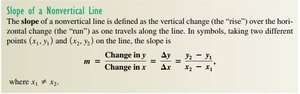
The slope of a line is a fundamental concept in business calculus, representing the "steepness" or rate of change of a straight line. It is defined as the ratio of the vertical change (rise) to the horizontal change (run) between two points on the line. This concept is crucial for understanding linear relationships in business applications, such as cost, revenue, and profit functions.
Definition: The slope (m) is given by the formula:
Interpretation: The slope measures how much y changes for each unit increase in x.
Horizontal lines: Slope = 0 (parallel to the x-axis).
Vertical lines: Slope is undefined (parallel to the y-axis).
Special Cases and Cautions
It is important to use precise terminology when discussing slopes. For vertical lines, the slope is undefined, not "no slope." For horizontal lines, the slope is zero.
Horizontal line: Slope = 0
Vertical line: Slope is undefined
Caution: Avoid saying "no slope" for vertical lines; the correct term is "undefined slope."

Equations of Lines
Linear equations can be written in several forms, each useful for different applications in business calculus. Understanding these forms allows for modeling and solving real-world business problems.
Slope-intercept form: Where m is the slope and b is the y-intercept.
Point-slope form: Used when a point (x_1, y_1) and the slope m are known.
Vertical line: Has an undefined slope; no y-intercept except when k = 0.
Horizontal line: Has a slope of 0; no x-intercept except when k = 0.
Equation | Description |
|---|---|
Slope-intercept form: slope m, y-intercept b | |
Point-slope form: slope m, line passes through (x1, y1) | |
Vertical line: x-intercept k, no y-intercept (except when k = 0), undefined slope | |
Horizontal line: y-intercept k, no x-intercept (except when k = 0), slope 0 |

Intercepts
Intercepts are points where the line crosses the axes, which are important for interpreting business models.
Y-intercept: The point where the line crosses the y-axis, given by (0, b).
X-intercept: The point where the line crosses the x-axis, found by setting y = 0 and solving for x.
Linear Functions and Applications
Linear Functions in Business Context
Many business situations involve two variables related by a linear equation. Expressing one variable in terms of another allows for modeling and analysis of business processes.
Function notation: or (e.g., )
Independent variable: Usually x (e.g., quantity, price)
Dependent variable: Usually y (e.g., cost, revenue)
Business Vocabulary and Notation
Quantity demanded (q): The amount of a product consumers are willing to buy.
Price (p): The cost per unit of a product.
Marginal cost: The cost of producing one additional item; represented by the slope of the cost function.
Revenue: The total amount of money a company receives from sales.
Profit: The amount of money a company makes after paying its costs.
Equilibrium: The point where supply and demand are equal.
Equilibrium price: The price at which supply and demand are equal.
Equilibrium quantity: The quantity at which supply and demand are equal.
Business Equations
Cost analysis: Where m = marginal cost, b = fixed cost.
Break-even analysis: Revenue equals cost; break-even quantity is the x value where profit is zero.
Revenue function: Where p = price per unit, x = number of units sold.
Profit function: Profit is revenue minus cost.
Example: If a company sells widgets at C(x) = 2x + 100 R(x) = 5x R(x) = C(x) $.
