 Back
BackAssociation Between Categorical Variables: Contingency Tables, Lurking Variables, and Strength of Association
Study Guide - Smart Notes
 Tailored notes based on your materials, expanded with key definitions, examples, and context.
Chapter 5: Association Between Categorical Variables
5.1 Contingency Tables
Contingency tables are a fundamental tool in business statistics for analyzing the relationship between two categorical variables. They display the frequency distribution of variables and help identify associations between them.
Definition: A contingency table (also called a cross-tabulation or crosstab) shows the counts of cases for every combination of two categorical variables. Each cell represents a unique combination of the variables.
Example: Analyzing which web hosts send more buyers to Amazon.com by cross-tabulating Host (Comcast, Google, Nextag) and Purchase (Yes/No).
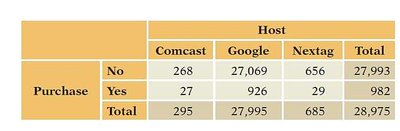
Marginal and Conditional Distributions
Contingency tables allow us to compute two important types of distributions:
Marginal Distribution: The totals for each category of a single variable, found in the margins (last row/column) of the table.
Conditional Distribution: The distribution of one variable for a fixed value of the other variable (e.g., the percentage of purchases for each host).
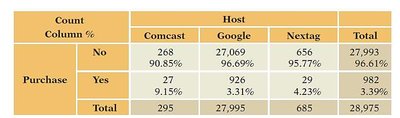
Interpretation: The conditional distribution reveals that Comcast has the highest purchase rate, indicating an association between Host and Purchase.
Visualizing Contingency Tables
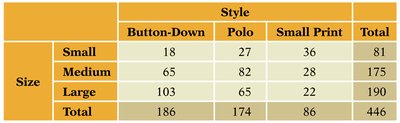
Stacked Bar Charts: These display conditional distributions by dividing bars into segments proportional to the percentage in each group of a second variable.
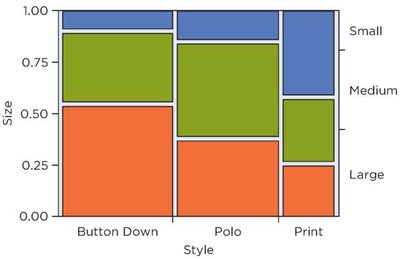
Mosaic Plots: An alternative visualization where the size of each tile is proportional to the count in a cell of the contingency table.
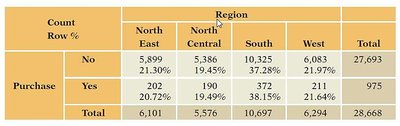
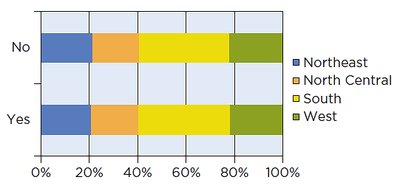
5.2 Lurking Variables and Simpson’s Paradox
It is important to remember that association does not imply causation. Sometimes, a third variable (a lurking variable) can influence the observed relationship between two variables, leading to misleading conclusions.
Lurking Variable: A hidden variable that affects the apparent relationship between two other variables.
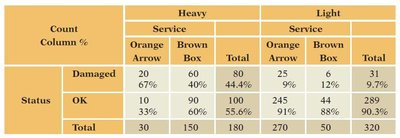
Simpson’s Paradox: The direction or strength of an association between two variables can change when data are separated into groups defined by a third variable.
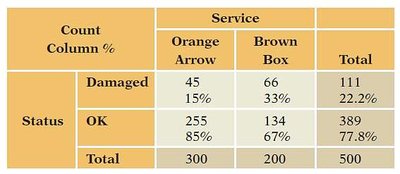
Example: Orange Arrow appears to be a better shipper until the data are separated by package weight, revealing the effect of the lurking variable.
5.3 Strength of Association
To quantify the association between categorical variables, statisticians use the Chi-Squared Statistic and related measures.
Chi-Squared Statistic (\( \chi^2 \)): Measures how much the observed counts in a contingency table differ from the counts expected if the variables were independent.
Formula:
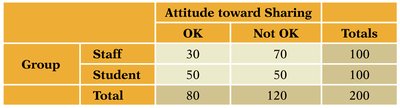

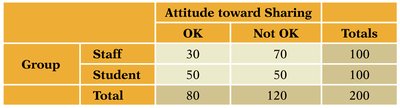
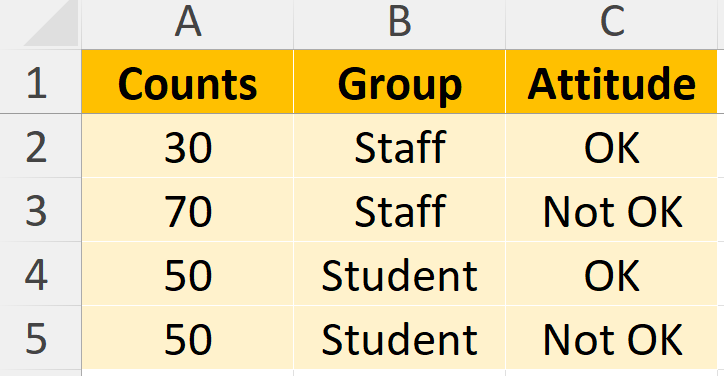
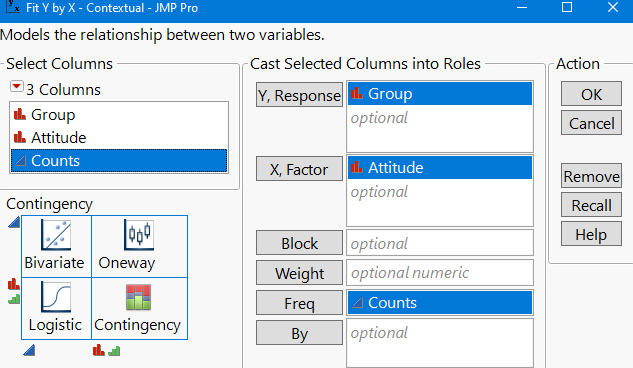
Example Calculation:
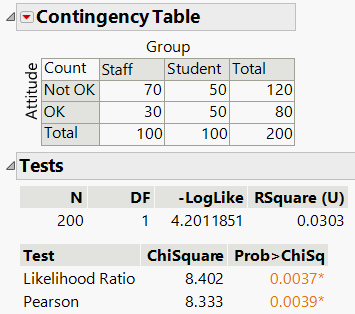
Cramer’s V
Cramer’s V is a normalized measure of association derived from the Chi-Squared statistic, ranging from 0 (no association) to 1 (perfect association).
Formula:
Where n is the total sample size, r is the number of rows, and c is the number of columns.
Checklist for Chi-Squared and Cramer’s V
Verify that variables are categorical.
Check for the presence of lurking variables before interpreting association.
Summary Table: Key Contingency Table Concepts
Concept | Definition | Example |
|---|---|---|
Contingency Table | Table showing counts for combinations of two categorical variables | Host vs. Purchase |
Marginal Distribution | Totals for each category of a single variable | Total Purchases by Host |
Conditional Distribution | Distribution of one variable for a fixed value of another | Purchase rate for each Host |
Lurking Variable | Hidden variable affecting observed association | Weight in shipping example |
Simpson’s Paradox | Association changes when data are grouped by a third variable | Shipping service by weight |
Chi-Squared Statistic | Quantifies difference between observed and expected counts | Attitude toward sharing by group |
Cramer’s V | Normalized measure of association (0 to 1) | Strength of association in contingency table |
