 Back
BackChapter 23: Multiple Regression – Business Statistics Study Notes
Study Guide - Smart Notes
 Tailored notes based on your materials, expanded with key definitions, examples, and context.
Multiple Regression Model
Introduction to Multiple Regression
Multiple regression is a statistical technique used to model the relationship between a response variable and two or more explanatory variables. It allows researchers to separate the effects of each explanatory variable and determine which variables significantly impact the response.
Definition: The multiple regression model (MRM) describes the association in the population between multiple explanatory variables and a response.
Equation: The response variable Y is linearly related to k explanatory variables X1, X2, ..., Xk by the equation: where (errors are independent, have equal variance, and are normally distributed).
Comparison: Simple regression bundles all but one explanatory variable into the error term, while multiple regression includes several variables in the model.
Residuals: Departures from normality in residuals may indicate omitted explanatory variables.
Interpreting Multiple Regression
Example: Women’s Apparel Stores
This example models annual sales per square foot in a chain of women’s apparel stores using two explanatory variables: median household income in the area and the number of competing apparel stores in the same mall.
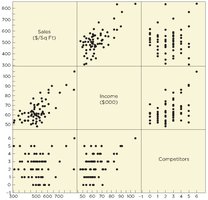
Scatterplot Matrix: Used to visualize relationships between variables before fitting the model.
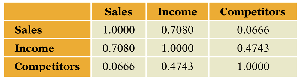
Correlation Matrix: Quantifies the strength and direction of linear relationships between variables.
Fitting the Model
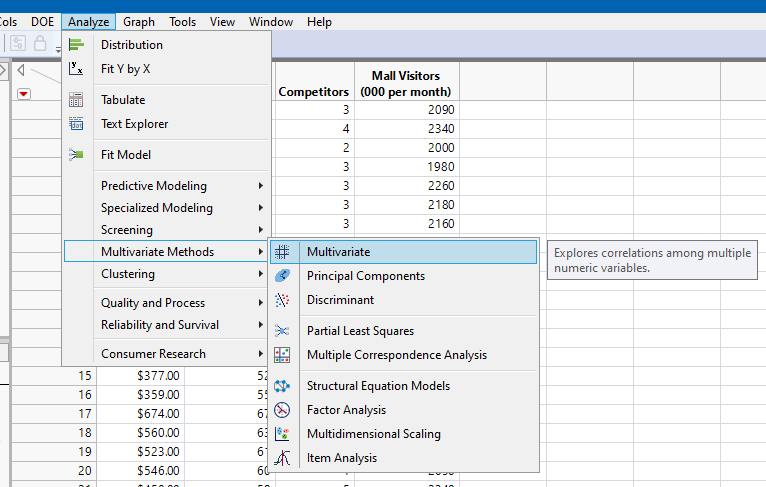
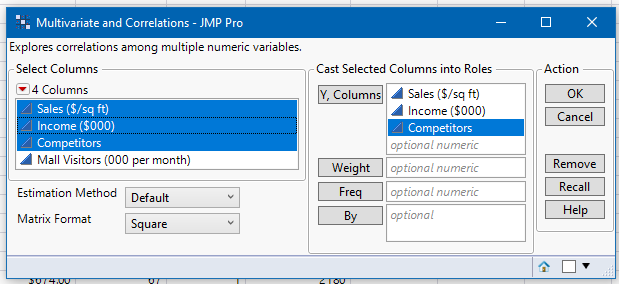
To fit the model, select the response and explanatory variables in statistical software.
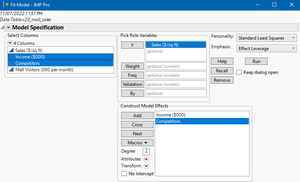
Model Equation and Interpretation
Fitted Model:
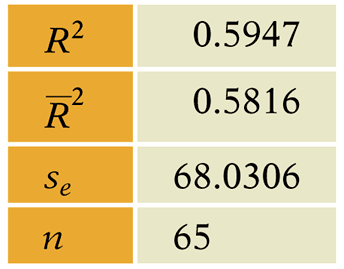
R-squared (): Indicates the proportion of variance in sales explained by the model. Here, (59.47%).
Adjusted R-squared: Adjusts for sample size and number of variables; always less than .
Standard error (): Measures the average distance that the observed values fall from the regression line. Here, .
Calibration Plot
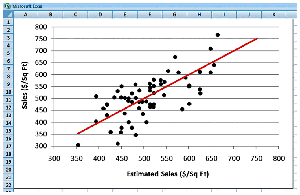
A calibration plot compares observed sales to fitted values. The tighter the data cluster along the diagonal, the higher the .
Marginal and Partial Slopes
Partial Slope: The slope of an explanatory variable in multiple regression, controlling for other variables.
Marginal Slope: The slope in simple regression, not controlling for other variables.
Interpretation: Partial and marginal slopes only agree when explanatory variables are uncorrelated.
Path Diagram and Collinearity
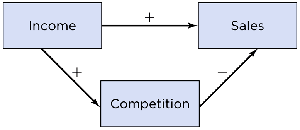
Path Diagram: Schematic drawing showing direct and indirect effects among variables.
Collinearity: High correlations among explanatory variables can make estimates unreliable.
Checking Conditions for Inference
Residual Plots
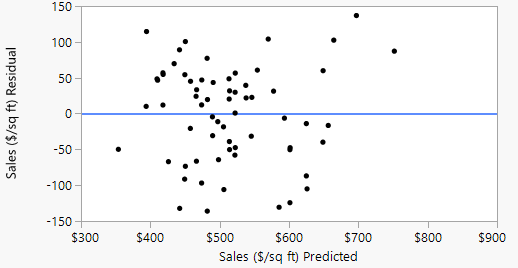
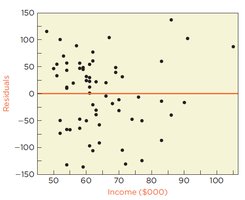
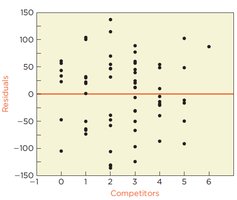
Residual plots are used to check model assumptions: independence, equal variance, and normality of errors.
Residuals vs. Fitted Values: Used to identify outliers and check for equal variance.
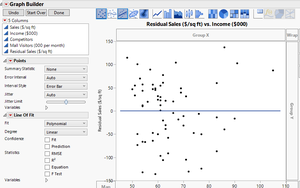
Residuals vs. Explanatory Variables: Used to verify linear relationships.
Normality Check
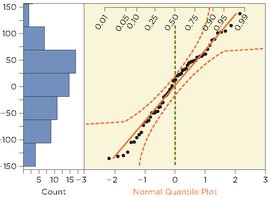
Normal quantile plots and histograms are used to check if residuals are approximately normally distributed.
Inference in Multiple Regression
F-test for Model
The F-test evaluates the explanatory power of the model as a whole. The F-statistic is the ratio of the variance explained by the model to the variance of the residuals.
Null Hypothesis (): All slopes are equal to zero.
Interpretation: A low p-value indicates that the model explains significant variation in the response.

Inference for Individual Coefficients
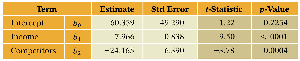
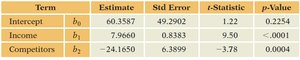
The t-test is used to test whether each slope is significantly different from zero.
Null Hypothesis (): for each coefficient.
Interpretation: Significant t-statistics and low p-values indicate that the explanatory variable has a significant effect.
Confidence Intervals
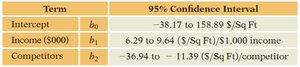
Confidence intervals provide a range of plausible values for each coefficient, consistent with t-test results.
Prediction Intervals
A prediction interval estimates the range in which a new observation is likely to fall, given specific values of the explanatory variables. For example, a 95% prediction interval for sales at a location with median income of $70,000 and 3 competitors is $545.48 \pm $137.29 per square foot.
Steps in Fitting a Multiple Regression
Step-by-Step Process
Define the Problem: Identify the response and explanatory variables relevant to the business question.
Visualize Relationships: Use scatterplot matrices to check for linear relationships.
Fit the Model: If relationships are linear, fit the multiple regression model; otherwise, consider transformations.
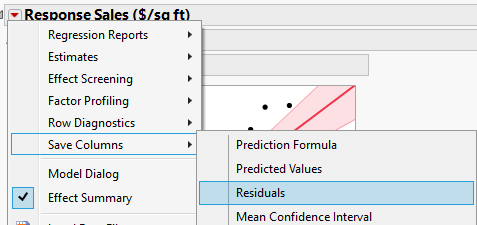
Check Residuals: Obtain residuals and fitted values, and make scatterplots to check for equal variance and dependence.
Check Normality: Use quantile plots and histograms to verify normality of residuals.
Test Model Significance: Use the F-statistic to test if explanatory variables collectively affect the response.
Interpret Partial Slopes: If the F-statistic is significant, interpret individual partial slopes and their confidence intervals.
