 Back
BackChapter 4: Introduction to Probabilities – Business Statistics Study Guide
Study Guide - Smart Notes
 Tailored notes based on your materials, expanded with key definitions, examples, and context.
Introduction to Probabilities
Definition and Scope
Probability is a fundamental concept in statistics, representing the likelihood that a specific event will occur. It is expressed as a numerical value between 0 and 1, where 0 indicates impossibility and 1 indicates certainty. Probabilities are used to quantify uncertainty and make informed decisions in business and other fields.
Probability Value: Ranges from 0 (impossible event) to 1 (certain event).
Application: Used in risk assessment, forecasting, and quality control.
Key Definitions
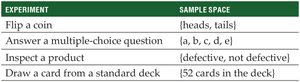
Experiment: The process of measuring or observing an activity to collect data. Example: Rolling a die.
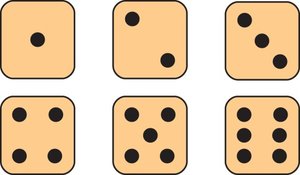
Sample Space: The set of all possible outcomes of an experiment. Example: For a die, {1, 2, 3, 4, 5, 6}.
Event: One or more outcomes from the sample space. Example: Rolling an even number.
Simple Event: An event with a single outcome that cannot be further simplified. Example: Rolling a five.
Methods of Assigning Probability
Classical, Empirical, and Subjective Probability
There are three primary methods for assigning probabilities:
Classical Probability: Used when all outcomes are equally likely and known. Formula:
Empirical Probability: Based on observed frequencies from experiments. Formula:
Subjective Probability: Based on intuition, experience, or expert judgment when classical and empirical data are unavailable.
Classical Probability Example
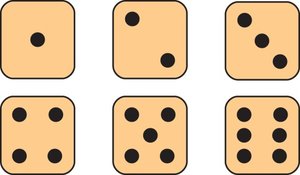
Rolling a die once: Sample space = {1, 2, 3, 4, 5, 6}. Probability of rolling a five:
(16.7%)
Empirical Probability Example
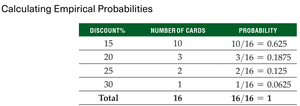
Empirical probability is calculated from observed data. For example, a store offers 16 discount cards with varying probabilities:

Law of Large Numbers
The law of large numbers states that as an experiment is repeated many times, the empirical probability approaches the classical probability.
Subjective Probability
Used when neither classical nor empirical probabilities are available.
Relies on expert judgment or intuition.
Example: Estimating the probability of a competitor reducing prices.
Basic Properties and Rules of Probability
Probability Rules
Rule 1: If , Event A must occur.
Rule 2: If , Event A will not occur.
Rule 3: Probability values must be between 0 and 1.
Rule 4: The sum of probabilities for all simple events in the sample space equals 1.
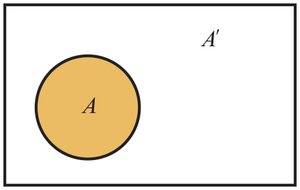
Rule 5 (Complement Rule): The complement of Event A, denoted as A', includes all outcomes not in A. or
Probability Rules for More Than One Event
Contingency Tables
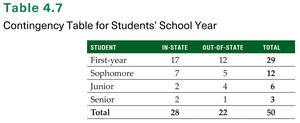
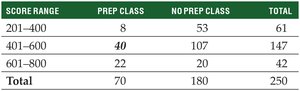
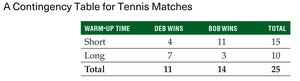
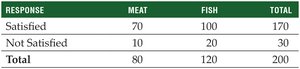
Contingency tables classify occurrences of events according to two categorical variables. They are used to calculate probabilities such as marginal, joint, and conditional probabilities.

Intersection and Union of Events
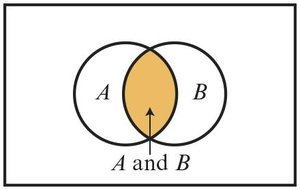
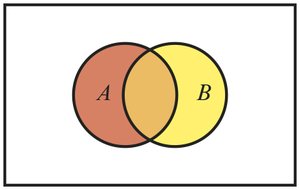
Intersection (Joint Probability): Probability that both events A and B occur.
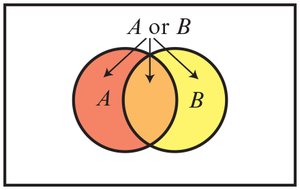
Union: Probability that either event A or B or both occur.
Addition Rule
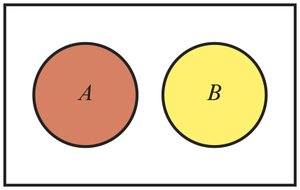
Mutually Exclusive Events: Cannot occur at the same time.
Not Mutually Exclusive:
Conditional Probability
Definition and Calculation
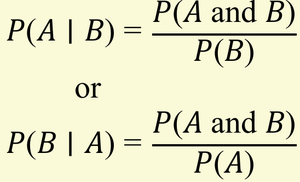
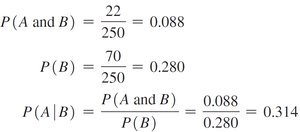
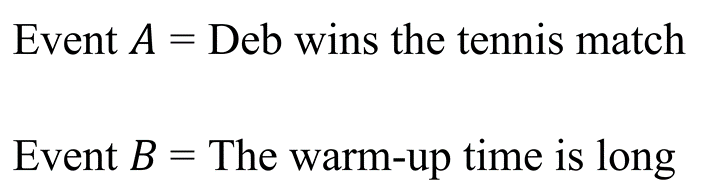
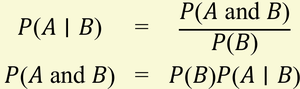
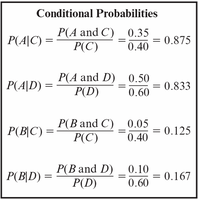
Conditional probability is the probability of Event A occurring given that Event B has occurred. It is calculated using:
Independent and Dependent Events
Definitions
Independent Events: The occurrence of one event does not affect the probability of the other.
Dependent Events: The occurrence of one event affects the probability of the other.
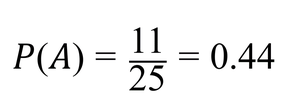
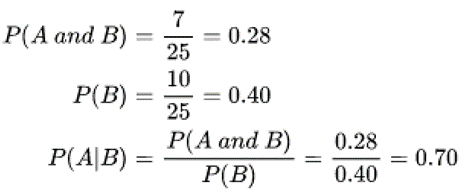
Multiplication Rule
Multiplication Rule for Dependent and Independent Events
Dependent Events:
Independent Events:
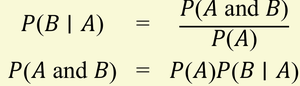
Example: Dependent Events
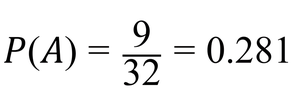
Probability of selecting two low-salt potato chip bags from a shelf:
First bag:
Second bag (given first was low-salt):
Joint probability:
Contingency Tables with Probabilities
Frequency and Probability Tables
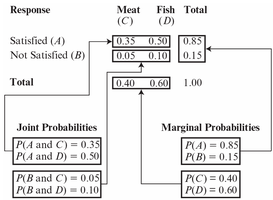
Contingency tables can be converted to probability tables by dividing each frequency by the total number of observations.

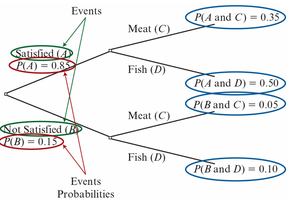

Bayes’ Theorem
Definition and Application
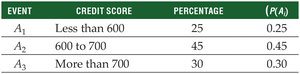
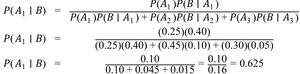
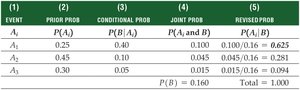
Bayes’ Theorem is used to revise probabilities based on new information. It is especially useful for updating the probability of an event given the occurrence of another event.
Formula for n events:
Counting Principles
Fundamental Counting Principle
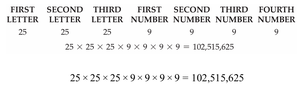
The fundamental counting principle states that if there are k1 choices for the first event, k2 for the second, ..., kn for the nth event, the total number of possible outcomes is .
Permutations
Permutations refer to the number of ways objects can be arranged in order. The number of permutations of n distinct objects is (factorial).
Formula for permutations of n objects taken x at a time:

Combinations
Combinations refer to the number of ways objects can be selected without regard to order. The formula for combinations of n objects taken x at a time is:
Example: In poker, the number of five-card combinations from a deck of 52 cards is .
Additional info: All formulas are provided in LaTeX format for clarity and academic rigor. Tables and diagrams are included only when directly relevant to the explanation.
