 Back
BackContinuous Probability Distributions: Normal, Exponential, and Uniform Distributions
Study Guide - Smart Notes
 Tailored notes based on your materials, expanded with key definitions, examples, and context.
Chapter 6: Continuous Probability Distributions
6.1 Continuous Random Variables
Continuous random variables are variables that can take any value within a specified interval. They are distinguished from discrete random variables, which can only take specific, separate values. The probability of a continuous random variable taking any exact value is always zero; instead, probabilities are assigned to intervals of values.
Definition: A continuous random variable is a variable whose possible values form an interval of numbers.
Measurement Precision: The value depends on the precision of measurement (e.g., time to the nearest second, millisecond, etc.).
Probability: Probability is determined for intervals, not specific values.
6.2 Continuous Probability Distributions
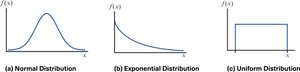
Continuous probability distributions describe the likelihood of all possible values of a continuous random variable. The three most common types are the normal, exponential, and uniform distributions.
Normal Distribution: Data tend to cluster around a central value, with rare occurrences of extreme values.
Exponential Distribution: Lower values are more common, and higher values are rare.
Uniform Distribution: All values within a certain interval are equally likely.
6.2.1 Normal Probability Distributions
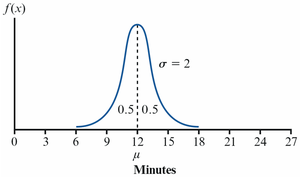
The normal distribution is a bell-shaped, symmetrical distribution centered around the mean. It is widely used in statistics due to its natural occurrence in many real-world phenomena.
Symmetry: The distribution is symmetric about the mean (μ), so the mean and median are equal.
Probability Density Function (PDF): The total area under the curve is 1.0, with 0.5 to the left and right of the mean.
Tails: The curve extends indefinitely in both directions, never touching the horizontal axis.
Parameters of the Normal Distribution
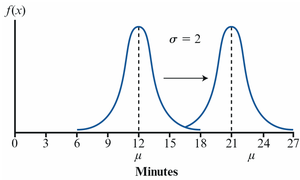
Mean (μ): Determines the center of the distribution.
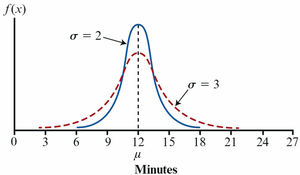
Standard Deviation (σ): Determines the spread or width of the distribution.
Effect of Changing Parameters: Changing μ shifts the curve left or right; changing σ stretches or compresses the curve.
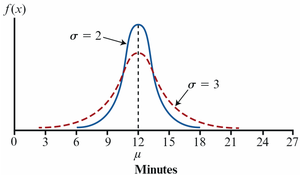
Normal Probability Density Function (PDF)
The mathematical formula for the normal PDF is:

e: Euler's number, approximately 2.71828
π: Pi, approximately 3.14159
μ: Mean of the distribution
σ: Standard deviation of the distribution
x: Value of interest
Standard Normal Distribution and z-Scores
The standard normal distribution is a special case with μ = 0 and σ = 1. Any normal distribution can be converted to the standard normal using the z-score formula:
z-Score: Indicates how many standard deviations a value x is from the mean.
Negative z: x is below the mean.
Positive z: x is above the mean.
At the mean: z = 0.
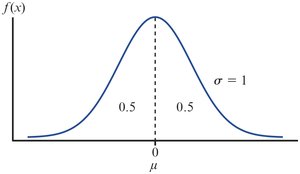
Calculating Probabilities Using z-Scores
To find probabilities, convert x to a z-score and use the standard normal table (z-table) to find the area under the curve.
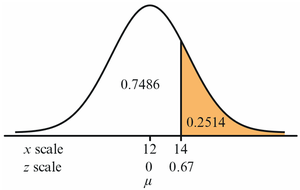
Example: Mean call time μ = 12 min, σ = 3 min. Probability that a call lasts 14 min or less?

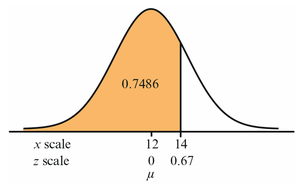
From the z-table, P(z ≤ 0.67) ≈ 0.7486
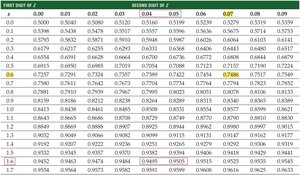
Finding x for a Given Probability
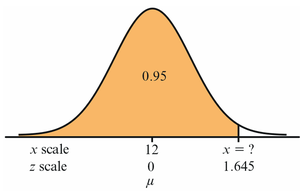
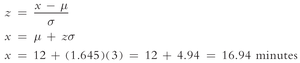
To find the value x corresponding to a cumulative probability (e.g., 95%), use the z-score for that probability and solve for x:
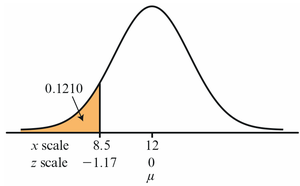
Negative z-Scores
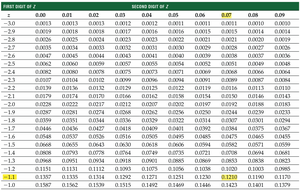
For values below the mean, z is negative. Use the z-table for negative values to find probabilities.
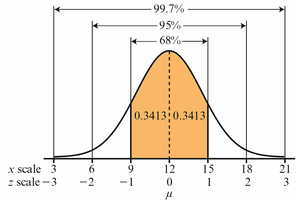
The Empirical Rule
The empirical rule states that for a normal distribution:
68% of values fall within 1 standard deviation of the mean
95% within 2 standard deviations
99.7% within 3 standard deviations
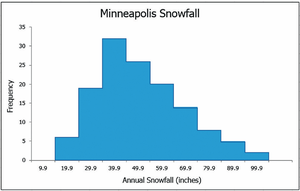
Probability Intervals: Real-World Example
Suppose annual snowfall in Minneapolis is normally distributed with μ = 46 in., σ = 18.5 in. What is the probability that snowfall is between 30 and 70 inches?
Calculate z-scores for x = 30 and x = 70:
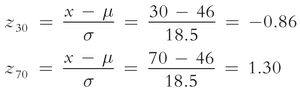
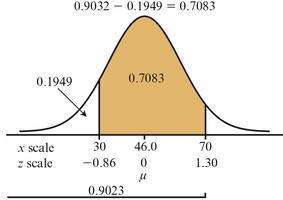
From the z-table:

Other Probability Intervals
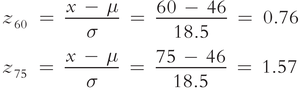
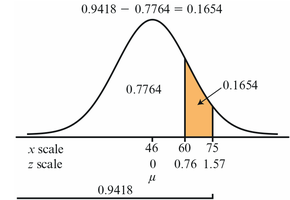
Probability between 60 and 75 inches: Calculate z-scores, find areas, and subtract as above.

Excel Functions for Normal Probabilities
NORM.DIST(x, mean, standard_dev, cumulative): Returns the cumulative probability for a normal distribution.
NORM.S.DIST(z, cumulative): Returns the cumulative probability for the standard normal distribution.
6.2.2 Using the Normal Distribution to Approximate the Binomial Distribution
When the sample size is large and both np ≥ 5 and nq ≥ 5, the normal distribution can approximate the binomial distribution. A continuity correction (±0.5) is applied when converting discrete x values to the continuous normal scale.
Application: Used in quality control and other business contexts.
Continuity Correction: Add or subtract 0.5 to x when using the normal approximation.
6.3 Exponential Probability Distributions
The exponential distribution models the time between events in a process where events occur continuously and independently at a constant average rate.
Right-Skewed: Most values are near zero, with a long tail to the right.
Parameter: Defined by λ (rate of occurrence).
PDF: for x ≥ 0
Mean:
Standard Deviation:
6.4 Uniform Probability Distributions
In a continuous uniform distribution, all intervals of the same length within the distribution's range are equally probable.
PDF: for
CDF: for
Mean:
Standard Deviation:
Example: Exam Completion Time
If exam times are uniformly distributed between 70 and 120 minutes, the probability that a student finishes in less than 80 minutes is:
Summary Table: Key Properties of Continuous Distributions
Distribution | Shape | Parameters | Mean | Standard Deviation | |
|---|---|---|---|---|---|
Normal | Bell-shaped, symmetric | μ, σ | μ | σ | |
Exponential | Right-skewed | λ | |||
Uniform | Rectangular | a, b |
