 Back
BackContinuous Probability Distributions: Normal, Exponential, and Uniform Distributions
Study Guide - Smart Notes
 Tailored notes based on your materials, expanded with key definitions, examples, and context.
Continuous Probability Distributions
Overview of Continuous Probability Distributions
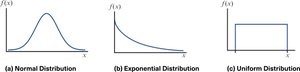
Continuous probability distributions describe the probabilities of the possible values of a continuous random variable. The three most common types are the Normal, Exponential, and Uniform distributions. Each has distinct characteristics and applications in business statistics.
Normal Distribution: Bell-shaped and symmetric, commonly used for naturally occurring data.
Exponential Distribution: Right-skewed, used for modeling time between events.
Uniform Distribution: All intervals of the same width are equally probable.
Continuous Random Variables
Definition and Properties
A continuous random variable can take any value within a given interval. The probability of the variable taking any exact value is zero; instead, probabilities are assigned to intervals. The precision of measurement affects the value observed.
Normal Probability Distributions
Characteristics of the Normal Distribution
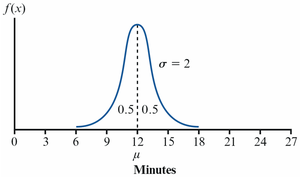
The normal probability distribution is bell-shaped and symmetric about the mean. It is widely used because many natural phenomena approximate this distribution. The mean (μ) and standard deviation (σ) fully describe its shape.
The mean, median, and mode are equal.
The total area under the curve is 1.0.
The distribution extends indefinitely in both directions.
Values near the mean are most probable.
Effect of Mean and Standard Deviation
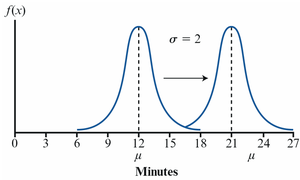
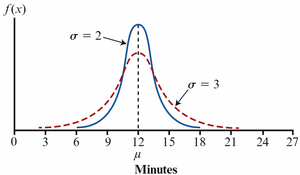
Changing the mean (μ) shifts the distribution left or right, while changing the standard deviation (σ) alters the spread of the curve.
Normal Probability Density Function
The mathematical expression for the normal probability density function is:

where: = mean = standard deviation = value of interest ,
The Standard Normal Distribution and z-Scores
The standard normal distribution is a special case with and . Any normal distribution can be converted to the standard normal using the z-score:
z-scores indicate how many standard deviations a value is from the mean.
Negative z-scores are below the mean; positive are above.
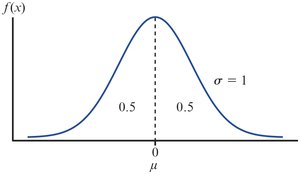
Calculating Probabilities Using z-Scores
To find the probability that a value falls below a certain point, calculate its z-score and use the standard normal table.
Example: For , , :

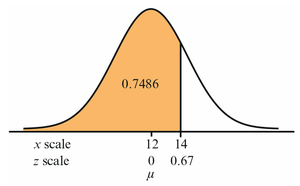
From the normal table, .
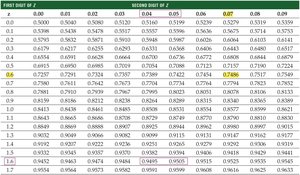
Finding Probabilities for Intervals
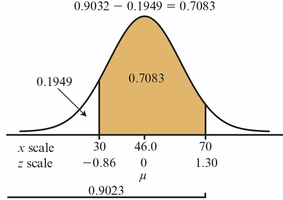
To find the probability that a value falls between two points, calculate the z-scores for both endpoints and subtract the smaller cumulative probability from the larger.
Example: Probability between and for , :

The Empirical Rule
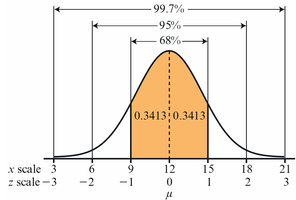
The empirical rule states that for a normal distribution:
68% of values fall within 1 standard deviation of the mean
95% within 2 standard deviations
99.7% within 3 standard deviations
Using Excel for Normal Probabilities
Excel functions for normal probabilities:
NORM.DIST(x, mean, standard_dev, cumulative): Returns the cumulative probability for a normal distribution.
NORM.S.DIST(z, cumulative): Returns the cumulative probability for the standard normal distribution.
Exponential Probability Distributions
Definition and Applications
The exponential probability distribution models the time between events in a process where events occur continuously and independently at a constant average rate. It is right-skewed and described by the parameter (rate).
Common applications: time between customer arrivals, time until equipment failure.
Probability Density Function
The exponential probability density function is:
, for
where is the rate parameter (mean number of occurrences per interval).
Cumulative Distribution Function
The cumulative distribution function (CDF) is:
Relationship to Poisson Distribution
If the number of events in an interval follows a Poisson distribution with mean , the time between events follows an exponential distribution with mean .
Excel for Exponential Probabilities
Excel function: EXPON.DIST(x, lambda, cumulative)
Set cumulative = TRUE for the cumulative probability.
Uniform Probability Distributions
Definition and Properties
The continuous uniform probability distribution assigns equal probability to all intervals of the same width within a specified range [a, b].
Probability density function: for
Cumulative distribution function: for
Mean and Standard Deviation
The mean and standard deviation for the uniform distribution are:
Mean: Standard deviation:
Example Application
Suppose the time to finish a statistics exam is uniformly distributed between 70 and 120 minutes. The probability that a student finishes in less than 80 minutes is:
Summary Table: Key Properties of Continuous Distributions
Distribution | Shape | Parameters | Typical Application |
|---|---|---|---|
Normal | Bell-shaped, symmetric | Mean (μ), Std. Dev. (σ) | Heights, test scores, measurement errors |
Exponential | Right-skewed | Rate (λ) | Time between arrivals, lifetimes |
Uniform | Rectangular | Min (a), Max (b) | Random number generation, waiting times |
