 Back
BackDiscrete Probability Distributions: Concepts, Calculations, and Applications
Study Guide - Smart Notes
 Tailored notes based on your materials, expanded with key definitions, examples, and context.
Discrete Probability Distributions
Introduction to Discrete Probability Distributions
Discrete probability distributions describe the likelihood of outcomes for discrete random variables, which take on countable values. These distributions are foundational in business statistics for modeling events such as customer arrivals, product defects, or survey responses.
Discrete Data: Outcomes are whole numbers (e.g., number of customers, defective items).
Continuous Data: Outcomes can take any value within a range (e.g., time, weight).
Probability Distribution: A listing of all possible outcomes and their associated probabilities for a discrete random variable.
Rules for Discrete Probability Distributions
For a valid discrete probability distribution, the following conditions must be met:
Each outcome is mutually exclusive.
Each probability is between 0 and 1, inclusive.
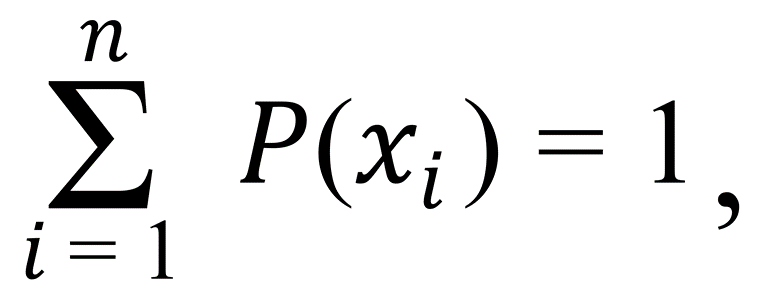
The sum of all probabilities equals 1:
Examples of Discrete Probability Distributions in Business
Counting the number of customers entering a store each hour.
Number of customers signing contracts in a sample.
Customer satisfaction ratings on a scale (e.g., 1–5).
Descriptive Measures for Discrete Probability Distributions
The Mean (Expected Value) of a Discrete Probability Distribution
The mean, or expected value ( or ), is the long-run average outcome of the random variable, weighted by probability:
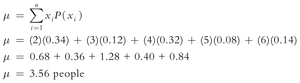
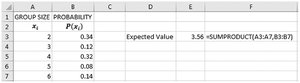
Example: Calculating the mean group size at Olive Garden using probabilities for each group size.
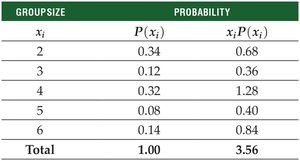
The mean is calculated as:
people
Variance and Standard Deviation of a Discrete Probability Distribution
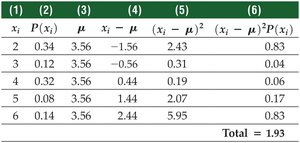
The variance () measures the spread of the distribution around the mean. The standard deviation () is the square root of the variance.
Variance formula:
Shortcut formula for variance:
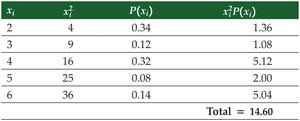
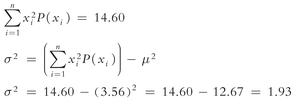
Example: For Olive Garden group sizes, people squared.
Comparing Distributions
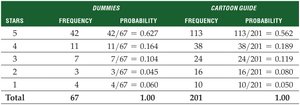
The mean and standard deviation allow for comparison between different distributions, such as customer ratings for two books.
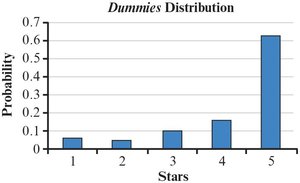
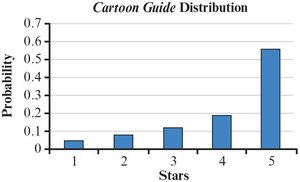
Expected Monetary Value (EMV)
Definition and Application
The expected monetary value is the mean of a discrete probability distribution when outcomes are measured in dollars. It represents the long-term average profit or loss for a project or decision.
Formula:
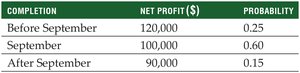

Example: For RAD Construction, the EMV is $103,500, calculated as:
Binomial Distributions
Characteristics of a Binomial Experiment
Fixed number of trials ()
Each trial has two possible outcomes: success () or failure ()
Probability of success and failure remains constant
Trials are independent
Binomial Probability Formula
The probability of exactly successes in trials is:

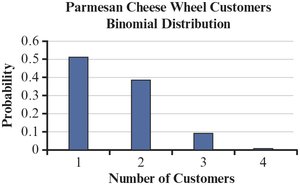
Example: Probability that one of three customers buys a cheese wheel (with ):



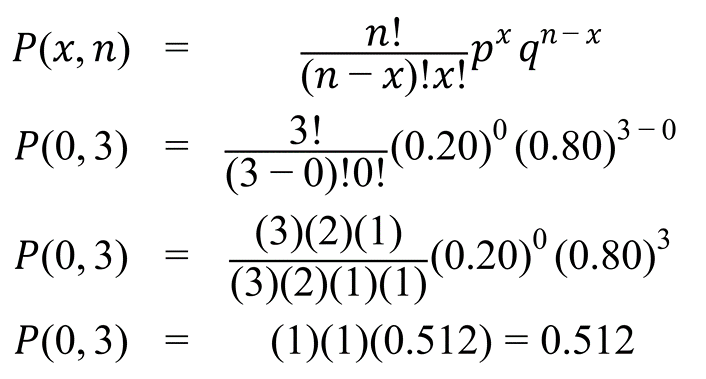
Probability that none buy:
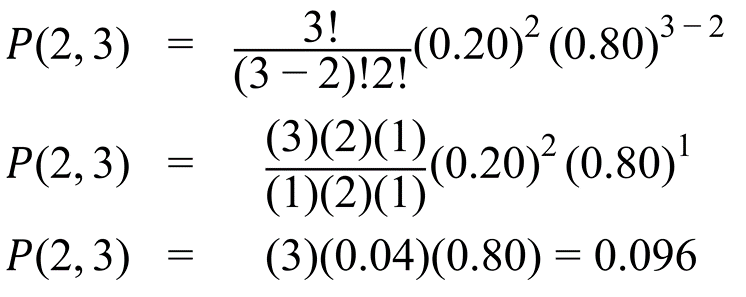
Probability that two buy:
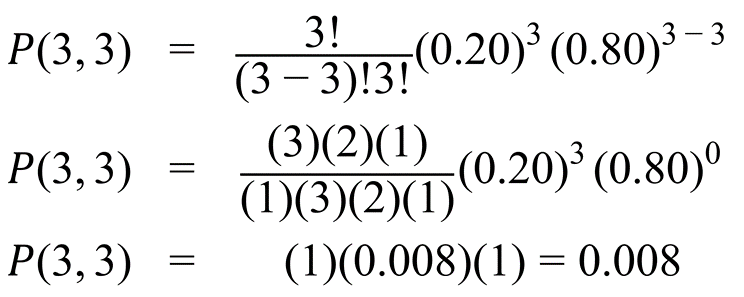
Probability that all three buy:
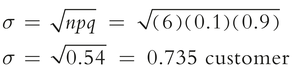
Mean and Standard Deviation of a Binomial Distribution
Mean:
Standard deviation:
Binomial Probability Tables and Excel
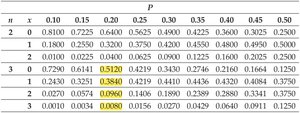
Binomial tables provide probabilities for various , , and values.
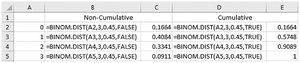
Excel function: =BINOM.DIST(x, n, p, cumulative)


Poisson Distributions
Characteristics of a Poisson Process
Counts the number of events in a fixed interval (time, area, etc.)
Mean rate () is constant for each interval
Events occur independently
Intervals do not overlap
Poisson Probability Formula
Variance of Poisson:
Poisson Distribution Example
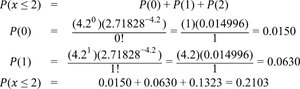
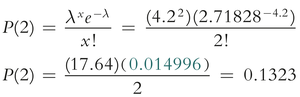
Example: Probability that exactly 2 customers miss appointments when :
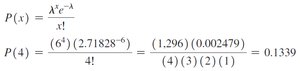
For arrivals: If 12 customers/hour, then for 30 minutes ; probability exactly 4 arrive:
Hypergeometric Distribution
Definition and Application
The hypergeometric distribution is used when sampling is done without replacement from a finite population, making trials dependent.
Population size:
Number of successes in population:
Sample size:
Number of successes in sample:
Probability formula:
Example: Probability that 5 of 7 laid-off employees are older, from a group of 22 with 8 older employees.
Mean:
Standard deviation:
*Additional info: The notes above include all key formulas, tables, and examples for discrete probability distributions, including binomial, Poisson, and hypergeometric distributions, as well as their applications in business contexts. The included images are directly relevant to the calculations and visualizations described in the text.*
