 Back
BackOptimization Methods in Business: Solving for Maximum Weekly Profit
Study Guide - Smart Notes
 Tailored notes based on your materials, expanded with key definitions, examples, and context.
Método de los Siguiente Modificado (Modified Successive Method)
Optimizing Weekly Production and Profit
This topic covers the application of optimization methods to maximize weekly profit in a business context, specifically for production and sales. The notes present a scenario where costs and revenues are modeled mathematically, and the optimal production quantity is determined using iterative methods.
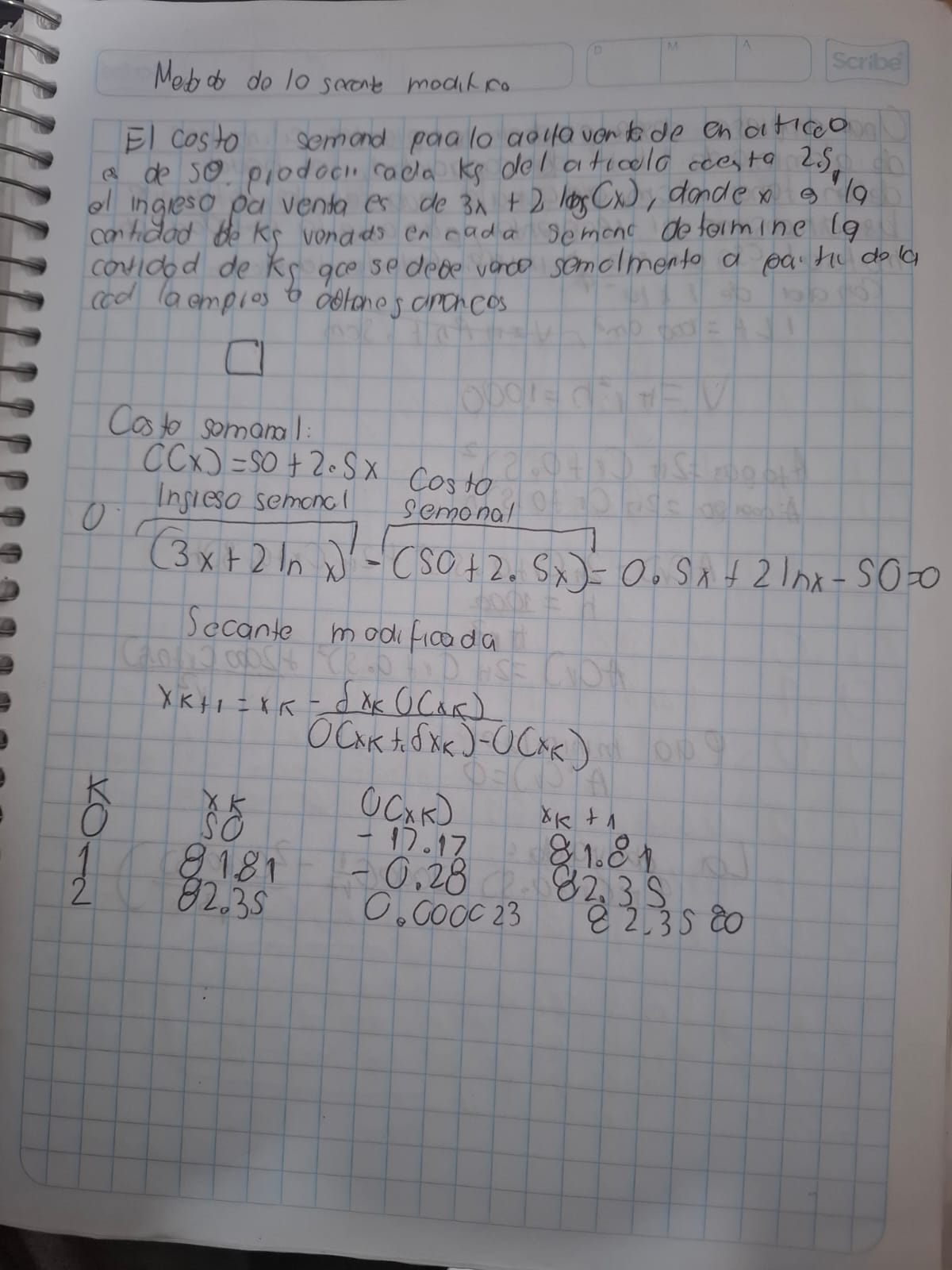
Weekly Cost Function: The weekly cost for producing a product is given by , where is the number of kilograms produced.
Weekly Revenue Function: The weekly income from sales is .
Profit Function: The weekly profit is calculated as .
Optimization Objective: Determine the value of that maximizes the weekly profit.
Formulating the Optimization Problem
To find the optimal production quantity, set the derivative of the profit function to zero and solve for :
Profit Function:
Derivative:
Set to Zero:
Solve for : (not feasible, so check calculations or use iterative methods)
Iterative Method: The notes use a modified successive method to iteratively approach the optimal .
Modified Successive Method (Método de los Siguiente Modificado)
This method involves updating the value of using the formula:
Update Formula:
Where: is the objective function evaluated at , and is a step size.
Iteration Table: The notes provide a table of values for , , , and .
Iteration Table
k | x_k | OC(x_k) | x_{k+1} |
|---|---|---|---|
0 | 80 | -17.17 | 81.81 |
1 | 81.81 | 0.28 | 82.35 |
2 | 82.35 | 0.00023 | 82.35 |
Purpose: The table shows the iterative process converging to the optimal value of .
Example Application
Scenario: A business produces and sells a product. The cost and revenue functions are given, and the goal is to maximize weekly profit.
Method: Use the modified successive method to find the optimal production quantity.
Result: The optimal is approximately 82.35 kg, where the profit function's derivative approaches zero.
Additional info: The iterative method is commonly used in business statistics and operations research to solve optimization problems where analytical solutions are difficult or infeasible. The process shown is a practical application of numerical optimization.
