 Back
Statistics for Business: Probability and Discrete Distributions Study Guide
Study Guide - Smart Notes
 Tailored notes based on your materials, expanded with key definitions, examples, and context.
Q1. What is probability?
Background
Topic: Probability Basics
This question is testing your understanding of what probability represents in statistics and business contexts.
Key Terms:
Probability: A numerical value between 0 and 1 that quantifies the likelihood of a specific event occurring.
Event: An outcome or set of outcomes of a random experiment.
Step-by-Step Guidance
Recall that probability measures how likely an event is to occur, expressed as a value between 0 (impossible) and 1 (certain).
Think about how probability is used to make business decisions under uncertainty.
Try solving on your own before revealing the answer!
Final Answer:
Probability is a numerical value that indicates the chance, or likelihood, of a specific event occurring.
Q2. What is a simple event? (Example: The first customer in the store today will be a female.)
Background
Topic: Types of Events in Probability
This question is testing your ability to identify and define simple events in probability.
Key Terms:
Simple Event: An event that consists of a single outcome from a sample space.
Sample Space: The set of all possible outcomes.
Step-by-Step Guidance
Understand that a simple event refers to one specific outcome, not a combination of outcomes.
Consider the example: "The first customer is a female"—this is a single, specific outcome.
Try solving on your own before revealing the answer!
Final Answer:
A simple event is an event that consists of a single outcome, such as "the first customer in the store today will be a female."
Q3. What must the sum of all probabilities for simple events in the sample space equal?
Background
Topic: Probability Rules
This question is testing your understanding of the fundamental rule that governs probability distributions.
Key Terms and Formula:
Sample Space: The set of all possible outcomes.
Probability Distribution: Assigns probabilities to each outcome.
Step-by-Step Guidance
Recall that the sum of probabilities for all possible outcomes must account for every possible event.
Think about why this rule ensures that the probability distribution is valid.
Try solving on your own before revealing the answer!
Final Answer:
The sum of all the probabilities for the simple events in the sample space must be equal to 1.
Q4. When are events A and B considered dependent?
Background
Topic: Dependent and Independent Events
This question is testing your understanding of the difference between dependent and independent events in probability.
Key Terms:
Dependent Events: Events where the occurrence of one affects the probability of the other.
Conditional Probability: is the probability of A given B has occurred.
Step-by-Step Guidance
Recall the definition of dependent events: .
Think about how knowing that B has occurred changes the likelihood of A.
Try solving on your own before revealing the answer!
Final Answer:
Events A and B are considered dependent if the probability of Event A given the occurrence of Event B is not equal to the probability of Event A occurring.
Q5. What is the mean of a discrete probability distribution?
Background
Topic: Discrete Probability Distributions
This question is testing your understanding of how to calculate the mean (expected value) of a discrete probability distribution.
Key Terms and Formula:
Mean (Expected Value): The weighted average of all possible outcomes.
Discrete Probability Distribution: A distribution of probabilities for discrete outcomes.
Step-by-Step Guidance
Recall that the mean is calculated by multiplying each outcome by its probability and summing the results.
Think about how this formula represents the "average" outcome you would expect over many trials.
Try solving on your own before revealing the answer!
Final Answer:
The mean of a discrete probability distribution is the weighted average of the outcomes of the random variables that comprise it.
Q6. Two six-sided die are rolled. What is the probability of the sum of the two die being 10?
Background
Topic: Probability of Compound Events
This question is testing your ability to calculate the probability of a specific sum when rolling two dice.
Key Terms and Formula:
Compound Event: An event involving more than one outcome.
Sample Space: All possible pairs of dice rolls.
Probability:
Step-by-Step Guidance
List all possible pairs of dice rolls that sum to 10 (e.g., (4,6), (5,5), (6,4)).
Count the number of favorable pairs.
Calculate the total number of possible outcomes when rolling two dice ().
Set up the probability formula using the counts from above.
Try solving on your own before revealing the answer!
Final Answer: 0.083
There are 3 pairs that sum to 10: (4,6), (5,5), (6,4). So .
This matches answer choice B.
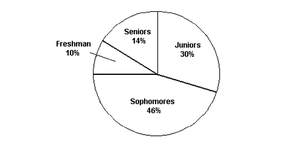
Q7. What percentage of the class consists of freshman, sophomores, and juniors?
Background
Topic: Data Visualization and Interpretation
This question is testing your ability to interpret a pie chart and sum relevant categories.
Key Terms:
Pie Chart: A circular chart divided into sectors representing proportions.
Percentage: The proportion out of 100.
Step-by-Step Guidance
Identify the percentages for freshman, sophomores, and juniors from the chart: 10%, 46%, and 30%.
Add these percentages together to find the total proportion of the class in these categories.
Try solving on your own before revealing the answer!
Final Answer: 86%
Freshman (10%) + Sophomores (46%) + Juniors (30%) = 86% of the class.
This matches answer choice D.
Q8. Which of the following is not a condition of a discrete probability distribution?
Background
Topic: Properties of Discrete Probability Distributions
This question is testing your knowledge of the requirements for a valid discrete probability distribution.
Key Terms:
Mutually Exclusive: No two outcomes can occur at the same time.
Probability Range: Each probability must be between 0 and 1.
Sum of Probabilities: Must add up to 1.
Step-by-Step Guidance
Review each condition listed in the answer choices and compare them to the standard requirements for a discrete probability distribution.
Identify which condition is not required or is incorrect.
Try solving on your own before revealing the answer!
Final Answer: B) The probability of a success must exceed the probability of a failure.
This is not a required condition for a discrete probability distribution.
Q9. The table displays the probabilities for each of the six outcomes when rolling a particular unfair die. Let A be the event that the number rolled is less than 4, and B be the event that the number rolled is odd. Find .
Background
Topic: Probability of Intersection of Events
This question is testing your ability to use a probability table to find the probability of two events occurring together.
Key Terms and Formula:
Intersection (): Both events occur.
Probability Table: Shows for each outcome.

Step-by-Step Guidance
Identify outcomes less than 4: 1, 2, 3.
Identify outcomes that are odd: 1, 3, 5.
Find outcomes that satisfy both conditions: 1 and 3.
Sum the probabilities for these outcomes using the table: .
Try solving on your own before revealing the answer!
Final Answer: 0.2
, , so .
This matches answer choice B.
Q10. When the discrete random variable is expressed in terms of dollars, what is the mean of the distribution called?
Background
Topic: Expected Value in Monetary Terms
This question is testing your understanding of terminology for expected value when the random variable represents money.
Key Terms:
Expected Value: The mean of a probability distribution.
Expected Monetary Value: The mean when outcomes are measured in dollars.
Step-by-Step Guidance
Recall that the expected value is the average outcome, weighted by probability.
When the outcomes are monetary, the expected value is referred to as the expected monetary value.
Try solving on your own before revealing the answer!
Final Answer: D) expected monetary value
When the random variable is in dollars, the mean is called the expected monetary value.
