Skip to main content
Calculus
My Course
Learn
Exam Prep
AI Tutor
Study Guides
Textbook Solutions
Flashcards
Explore
Try the app
My Course
Learn
Exam Prep
AI Tutor
Study Guides
Textbook Solutions
Flashcards
Explore
Try the app
Back
Antiderivatives definitions
You can tap to flip the card.
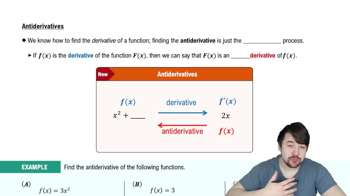
Antiderivative
You can tap to flip the card.
👆
Antiderivative
Reverse process of differentiation, yielding a function whose derivative matches the given function.
Track progress
Control buttons has been changed to "navigation" mode.
1/14
Related flashcards
Related practice
Recommended videos
Antiderivatives quiz #1
Antiderivatives
15 Terms
Antiderivatives
7. Antiderivatives & Indefinite Integrals
5 problems
Topic
Ernest
Indefinite Integrals
7. Antiderivatives & Indefinite Integrals
5 problems
Topic
Ernest
7. Antiderivatives & Indefinite Integrals
4 topics
11 problems
Chapter
Ernest
Guided course
05:50
Antiderivatives
1857
views
51
rank
Guided course
05:13
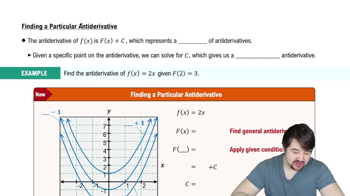
Finding a Particular Antiderivative
1297
views
49
rank
Terms in this set (14)
Hide definitions
Antiderivative
Reverse process of differentiation, yielding a function whose derivative matches the given function.
Derivative
Result of applying differentiation, representing the rate of change or slope of a function.
Constant of Integration
Unknown value added to an antiderivative, accounting for any constant lost during differentiation.
General Antiderivative
Family of functions differing by a constant, all having the same derivative as the original function.
Particular Antiderivative
Unique function from the general family, determined by an initial condition or given point.
Power Rule
Technique for finding derivatives or antiderivatives involving exponents, simplifying polynomial expressions.
Vertical Shift
Graph movement up or down, represented by the constant in the antiderivative.
Initial Condition
Given value for a function at a specific point, used to solve for the constant in an antiderivative.
Family of Functions
Set of functions differing only by a constant, all sharing the same derivative.
Function Notation
Symbolic representation such as f(x) or F(x), distinguishing between original and antiderivative functions.
Checking Solution
Process of differentiating an antiderivative to verify it returns the original function.
Polynomial
Expression involving terms with variables raised to whole-number exponents, often used in antiderivative examples.
Graph
Visual representation of a function, illustrating the effect of the constant in antiderivatives.
Output Value
Result of substituting a specific input into a function, used to determine the constant in a particular antiderivative.
 BackBack
 05:50
05:50