Skip to main content
Calculus
My Course
Learn
Exam Prep
AI Tutor
Study Guides
Textbook Solutions
Flashcards
Explore
Try the app
My Course
Learn
Exam Prep
AI Tutor
Study Guides
Textbook Solutions
Flashcards
Explore
Try the app
Back
Parametric Equations quiz
You can tap to flip the card.
What is a parametric equation?
You can tap to flip the card.
👆
What is a parametric equation?
A parametric equation expresses x and y in terms of a third variable, usually called t, the parameter.
Track progress
Control buttons has been changed to "navigation" mode.
1/15
Related flashcards
Related practice
Recommended videos
Parametric Equations definitions
Parametric Equations
15 Terms
Parametric Equations
16. Parametric Equations & Polar Coordinates
5 problems
Topic
Ernest
Calculus with Parametric Curves
16. Parametric Equations & Polar Coordinates
5 problems
Topic
16. Parametric Equations & Polar Coordinates
5 topics
14 problems
Chapter
Justin
08:02
Parameterizing Equations
352
views
5
rank
04:11
Eliminate Parameter: Equations with Trig
346
views
10
rank
04:39
Eliminate Parameter: Equations with Trig Example 3
296
views
9
rank
Terms in this set (15)
Hide definitions
What is a parametric equation?
A parametric equation expresses x and y in terms of a third variable, usually called t, the parameter.
How do you graph parametric equations?
Create a table of values for t, x(t), and y(t), then plot the corresponding (x, y) points on the plane.
What is the main difference between parametric equations and standard two-variable equations?
Parametric equations involve two equations for x and y in terms of t, while standard equations relate y directly to x.
What is a 'plane curve' in the context of parametric equations?
A plane curve is the graph of parametric equations, which can be a line, parabola, or other shapes.
How is the direction or orientation of a parametric curve indicated?
The direction is shown with arrows along the curve, indicating increasing t values.
What does 'eliminating the parameter' mean?
It means removing t from the equations to obtain a single equation involving only x and y.
What is the typical process for eliminating the parameter?
Solve one equation for t and substitute it into the other equation to get a rectangular equation.
Why might you only get part of a curve when graphing parametric equations?
Domain restrictions on t can limit the portion of the curve represented by the parametric equations.
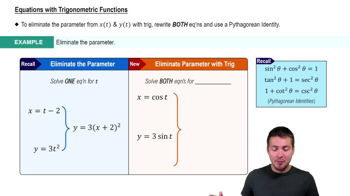
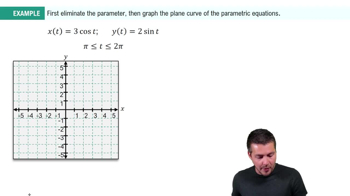
How do you eliminate the parameter in parametric equations involving trigonometric functions?
Solve for the trig functions in terms of x and y, then use a Pythagorean identity to relate them and eliminate t.
What Pythagorean identity is commonly used to eliminate the parameter in trig-based parametric equations?
The identity sin²(t) + cos²(t) = 1 is used to relate sine and cosine terms.
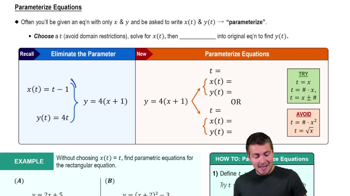
How do you parameterize a rectangular equation?
Choose a simple expression for t, solve for x(t), and substitute into the original equation to find y(t).
What should you avoid when choosing t for parameterization?
Avoid expressions that introduce domain restrictions, such as even powers or square roots of x.
How can you check if your parameterization is correct?
Eliminate the parameter from your parametric equations; you should recover the original rectangular equation.
How do you parameterize equations of circles or ellipses?
Rewrite the equation in the form f(x)² + g(y)² = 1, then set f(x) = cos(t) and g(y) = sin(t), solving for x(t) and y(t).
What is the result of eliminating the parameter from x = cos(t), y = 3sin(t)?
You get x² + (y/3)² = 1, which is the equation of an ellipse.
 BackBack
 08:02
08:02