Skip to main content
Calculus
My Course
Learn
Exam Prep
AI Tutor
Study Guides
Textbook Solutions
Flashcards
Explore
Try the app
My Course
Learn
Exam Prep
AI Tutor
Study Guides
Textbook Solutions
Flashcards
Explore
Try the app
Back
Related Rates definitions
You can tap to flip the card.
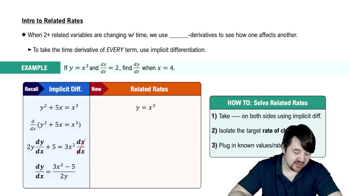
Implicit Differentiation
You can tap to flip the card.
👆
Implicit Differentiation
A method for finding derivatives when variables are interdependent, allowing calculation of rates even when explicit solutions are unavailable.
Track progress
Control buttons has been changed to "navigation" mode.
1/15
Related flashcards
Related practice
Recommended videos
Related Rates quiz
Related Rates
15 Terms
Related Rates
4. Applications of Derivatives
3 problems
Topic
Ernest
Linearization
4. Applications of Derivatives
3 problems
Topic
Jonathan
4. Applications of Derivatives
5 topics
10 problems
Chapter
Justin
Guided course
04:16
Intro To Related Rates
2384
views
60
rank
Guided course
06:16
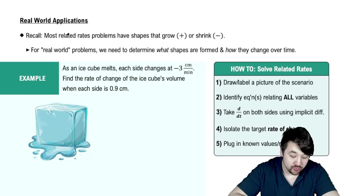
Real World Application
1179
views
15
rank
1
comments
Guided course
06:35
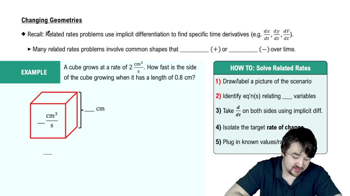
Changing Geometries
1659
views
45
rank
Terms in this set (15)
Hide definitions
Implicit Differentiation
A method for finding derivatives when variables are interdependent, allowing calculation of rates even when explicit solutions are unavailable.
Chain Rule
A rule for differentiating composite functions, essential for relating rates of change between dependent variables.
Time Derivative
A derivative taken with respect to time, indicating how a quantity changes as time progresses.
Related Rates
Problems involving two or more variables that change together over time, requiring differentiation to connect their rates.
Power Rule
A differentiation rule stating that the derivative of xⁿ is n·xⁿ⁻¹, used for finding rates in polynomial expressions.
Volume
A measure of three-dimensional space, often changing in geometric problems involving growth or shrinkage.
Side Length
A linear measurement of one edge of a geometric figure, such as a cube, which may vary over time.
Target Rate
The specific rate of change being sought in a problem, often isolated after differentiation.
Diagram
A labeled visual representation of a scenario, aiding in identifying variables and relationships in a problem.
Variable
A symbol representing a quantity that can change, such as x or V, crucial for expressing relationships in calculus.
Cubic Centimeter
A unit of volume measurement, commonly used in related rates problems involving three-dimensional objects.
Rate of Change
A measure of how one quantity varies with respect to another, typically time, central to related rates analysis.
Equation
A mathematical statement expressing the relationship between variables, foundational for setting up related rates solutions.
Shrinking
A process where a geometric figure decreases in size, indicated by negative rates in related rates problems.
Growth
An increase in size of a geometric figure, represented by positive rates in related rates scenarios.
 BackBack
 04:16
04:16