Skip to main content
Calculus
My Course
Learn
Exam Prep
AI Tutor
Study Guides
Textbook Solutions
Flashcards
Explore
Try the app
My Course
Learn
Exam Prep
AI Tutor
Study Guides
Textbook Solutions
Flashcards
Explore
Try the app
Back
Calculus: Limits and Derivatives of Trigonometric Functions
You can tap to flip the card.
What is the limit of \(\frac{\sin x}{x}\) as \(x \to 0\)?
You can tap to flip the card.
👆
What is the limit of \(\frac{\sin x}{x}\) as \(x \to 0\)?
The limit is \(1\).
Track progress
Control buttons has been changed to "navigation" mode.
1/20
Recommended videos
03:53
Derivatives of Sine & Cosine
2567
views
56
rank
01:32
Derivatives of Other Trig Functions Example 1
1374
views
36
rank
03:51
Higher Order Derivatives of Sine & Cosine
1807
views
37
rank
Terms in this set (20)
Hide definitions
What is the limit of \(\frac{\sin x}{x}\) as \(x \to 0\)?
The limit is \(1\).
What is the limit of \(\frac{\cos x - 1}{x}\) as \(x \to 0\)?
The limit is \(0\).
State the limit definition of the derivative for \(\sin x\).
The derivative is defined as \(\lim_{h \to 0} \frac{\sin(x+h) - \sin x}{h}\).
What is the derivative of \(\sin x\)?
The derivative is \(\cos x\).
What is the derivative of \(\cos x\)?
The derivative is \(-\sin x\).
State the angle addition formula for sine.
\(\sin(A+B) = \sin A \cos B + \cos A \sin B\).
State the angle addition formula for cosine.
\(\cos(A+B) = \cos A \cos B - \sin A \sin B\).
What is the derivative of \(\tan x\)?
The derivative is \(\sec^2 x\).
What is the derivative of \(\sec x\)?
The derivative is \(\sec x \tan x\).
What is the derivative of \(\cot x\)?
The derivative is \(-\csc^2 x\).
What is the derivative of \(\csc x\)?
The derivative is \(-\csc x \cot x\).
How do you apply the quotient rule to find the derivative of \(\tan x = \frac{\sin x}{\cos x}\)?
Use \(\frac{d}{dx} \left( \frac{N}{D} \right) = \frac{N' D - N D'}{D^2}\) with \(N=\sin x\) and \(D=\cos x\).
What is the limit of \(\frac{\sin 3x}{3x}\) as \(x \to 0\)?
The limit is \(1\).
What is the limit of \(\frac{\sin 2x}{x}\) as \(x \to 0\)?
The limit is \(2\).
What is the derivative of \(\sin(At+B)\) using the chain rule?
The derivative is \(A \cos(At+B)\).
What is the derivative of \(\cos(At+B)\) using the chain rule?
The derivative is \(-A \sin(At+B)\).
What is the derivative of \(\sec^2 x\)?
The derivative is \(2 \sec^2 x \tan x\) by chain rule.
What is the derivative of \(\log(2x)\) at \(x=0\)?
The derivative is undefined at \(x=0\) because \(\log(0)\) is undefined.
What is the derivative of \(\tan x\) using the quotient rule?
Using quotient rule on \(\frac{\sin x}{\cos x}\), derivative is \(\sec^2 x\).
What is the derivative of \(\sin x \cos x\) using the product rule?
The derivative is \(\cos^2 x - \sin^2 x\).
 BackBack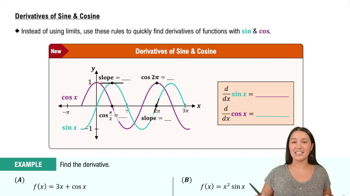
 03:53
03:53