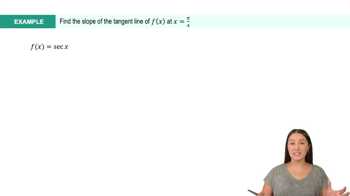
The derivative of \(\sec x\) is \(\sec x \tan x\).
Derivative of \(\csc x\)
The derivative of \(\csc x\) is \(-\csc x \cot x\).
General rule for derivative of trig functions
Use the standard derivatives of sine, cosine, tangent, cotangent, secant, and cosecant combined with the chain rule if the argument is not \(x\).
Derivative of \(\sin(kx)\) where \(k\) is constant
The derivative is \(k \cos(kx)\).
Derivative of \(\cos(kx)\) where \(k\) is constant
The derivative is \(-k \sin(kx)\).
Why is the derivative of \(\tan x\) equal to \(\sec^2 x\)?
Because \(\tan x = \frac{\sin x}{\cos x}\), applying the quotient rule yields \(\sec^2 x\).
Derivative of \(\cot x\) using quotient rule
Since \(\cot x = \frac{\cos x}{\sin x}\), its derivative is \(-\csc^2 x\).
Relationship between derivatives of \(\sec x\) and \(\tan x\)
The derivative of \(\sec x\) involves \(\tan x\) as \(\sec x \tan x\).
Derivative of \(\csc x\) involves which trig functions?
It involves \(\csc x\) and \(\cot x\) as \(-\csc x \cot x\).
How to remember the sign of trig derivatives?
Derivatives of sine and cosecant are positive times cosine and cotangent respectively; cosine, cotangent, and cosecant derivatives have a negative sign.
Derivative of \(\sin(-x)\)
Using chain rule, derivative is \(-\cos(-x) = -\cos x\).
Derivative of \(\cos(-x)\)
Using chain rule, derivative is \(\sin(-x) = -\sin x\).
Derivative of \(\tan(kx + c)\)
The derivative is \(k \sec^2(kx + c)\) where \(k, c\) are constants.
Use of chain rule with trig derivatives
Multiply the derivative of the trig function by the derivative of its inner function.
Derivative of \(\sec^2 x\)
Use the chain rule: derivative is \(2 \sec x \sec x \tan x = 2 \sec^2 x \tan x\).
Derivative of \(\csc^2 x\)
Using chain rule, derivative is \(2 \csc x (-\csc x \cot x) = -2 \csc^2 x \cot x\).
 Back
Back
 03:53
03:53