 Back
BackAbsolute and Conditional Convergence; The Ratio, Root, and Alternating Series Tests
Study Guide - Smart Notes
 Tailored notes based on your materials, expanded with key definitions, examples, and context.
Absolute and Conditional Convergence
Definition of Absolute Convergence
A series \( \sum a_n \) is said to converge absolutely (or is absolutely convergent) if the corresponding series of absolute values, \( \sum |a_n| \), converges.

Absolute convergence is a stronger form of convergence. If a series converges absolutely, it also converges in the usual sense.
Absolute convergence is important for determining the behavior of series with both positive and negative terms.
The Absolute Convergence Test
If \( \sum |a_n| \) converges, then \( \sum a_n \) also converges.

This test allows us to conclude convergence of a series by examining the series of absolute values.
Conditional Convergence
A series that converges, but does not converge absolutely, is said to converge conditionally.

Conditional convergence often occurs in alternating series, where the series converges, but the series of absolute values diverges.
The Ratio and Root Tests
The Ratio Test
The Ratio Test is a powerful tool for determining the convergence of series, especially those involving factorials, exponentials, or nth powers.
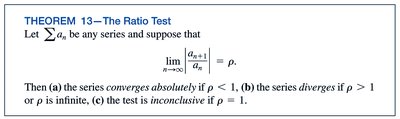
Let \( \sum a_n \) be any series and suppose that \( \lim_{n \to \infty} \left| \frac{a_{n+1}}{a_n} \right| = \rho \).
If \( \rho < 1 \), the series converges absolutely.
If \( \rho > 1 \) or \( \rho = \infty \), the series diverges.
If \( \rho = 1 \), the test is inconclusive.
The Root Test
The Root Test is especially useful for series where the nth term is raised to the nth power.
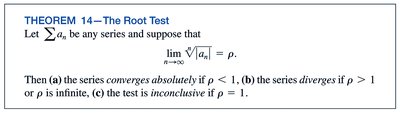
Let \( \sum a_n \) be any series and suppose that \( \lim_{n \to \infty} \sqrt[n]{|a_n|} = \rho \).
If \( \rho < 1 \), the series converges absolutely.
If \( \rho > 1 \) or \( \rho = \infty \), the series diverges.
If \( \rho = 1 \), the test is inconclusive.
Alternating Series and Conditional Convergence
The Alternating Series Test (Leibniz Test)
The Alternating Series Test provides a criterion for the convergence of series whose terms alternate in sign.
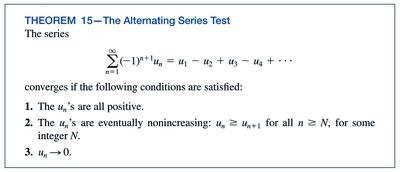
The series \( \sum_{n=1}^\infty (-1)^{n+1} u_n \) converges if:
All \( u_n \) are positive.
The sequence \( u_n \) is eventually nonincreasing: \( u_n \geq u_{n+1} \) for all \( n \geq N \) for some integer N.
\( u_n \to 0 \) as \( n \to \infty \).
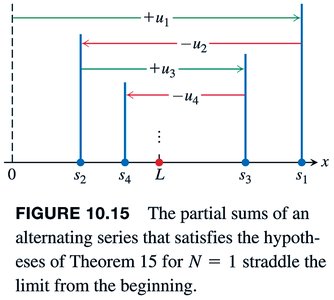
Figure 10.15: The partial sums of an alternating series that satisfies the hypotheses of Theorem 15 for N = 1 straddle the limit from the beginning.
Comparison: Harmonic vs. Alternating Harmonic Series
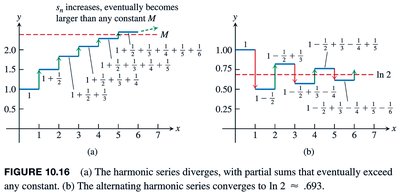
Figure 10.16(a): The harmonic series diverges, with partial sums that eventually exceed any constant M.
Figure 10.16(b): The alternating harmonic series converges to \( \ln 2 \approx 0.693 \).
The Alternating Series Estimation Theorem
This theorem provides an estimate for the error when approximating the sum of an alternating series by its partial sums.
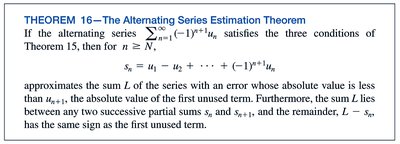
If the alternating series \( \sum_{n=1}^\infty (-1)^{n+1} u_n \) satisfies the three conditions of the Alternating Series Test, then for n \geq N, the partial sum \( s_n \) approximates the sum L of the series with an error whose absolute value is less than u_{n+1}, the absolute value of the first unused term.
The sum L lies between any two successive partial sums s_n and s_{n+1}, and the remainder L - s_n has the same sign as the first unused term.
Rearrangement of Series
The Rearrangement Theorem for Absolutely Convergent Series
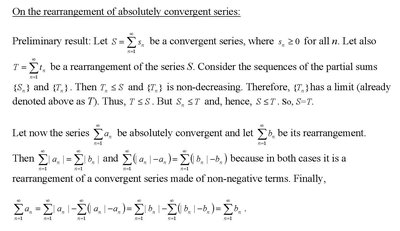
If a series is absolutely convergent, any rearrangement of its terms will converge to the same sum.
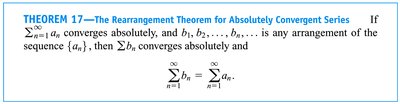
This property does not hold for conditionally convergent series, where rearrangement can lead to different sums or even divergence.
Summary of Series Tests
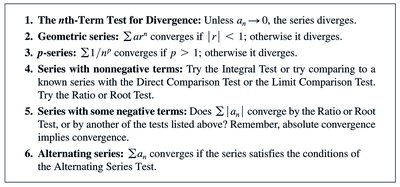
nth-Term Test for Divergence: If \( a_n \not\to 0 \), the series diverges.
Geometric Series: \( \sum ar^n \) converges if |r| < 1.
p-Series: \( \sum 1/n^p \) converges if p > 1.
Series with Nonnegative Terms: Use the Integral Test, Comparison Tests, Ratio or Root Test.
Series with Some Negative Terms: Test for absolute convergence using the Ratio or Root Test.
Alternating Series: Use the Alternating Series Test.
