 Back
BackAnalyzing Continuity, Differentiability, and Derivatives from a Graph
Study Guide - Smart Notes
 Tailored notes based on your materials, expanded with key definitions, examples, and context.
Q1a. For each given point, state Yes if the function is continuous and No if not:
Points: , , $0, , $2$
Background
Topic: Continuity of Functions
This question tests your understanding of continuity at specific points by examining the graph of a function. You need to determine whether the function is continuous at each listed point.
Key Terms:
Continuous at a point: A function is continuous at if and is defined.
Discontinuity: A break, jump, or hole in the graph at a specific point.
Step-by-Step Guidance
Examine the graph at each specified point. Look for breaks, jumps, or holes at , , $0, and $2$.
For each point, check if the function value exists and if the graph is unbroken at that location.
If the graph is connected and there is no jump or hole, the function is continuous at that point.
If there is a jump, hole, or the function value is missing, it is not continuous at that point.
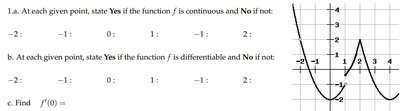
Try solving on your own before revealing the answer!
Q1b. For each given point, state Yes if the function is differentiable and No if not:
Points: , , $0, , $2$
Background
Topic: Differentiability of Functions
This question tests your ability to determine whether a function is differentiable at specific points by examining the graph. Differentiability requires continuity and a smooth (non-sharp) graph at the point.
Key Terms:
Differentiable at a point: A function is differentiable at if the derivative exists.
Sharp corner/cusp: A point where the graph changes direction abruptly, indicating non-differentiability.
Discontinuity: If a function is not continuous at a point, it cannot be differentiable there.
Step-by-Step Guidance
For each point, first check if the function is continuous (from part a).
Next, examine the graph for sharp corners, cusps, or vertical tangents at each point.
If the graph is smooth and continuous at the point, the function is likely differentiable there.
If there is a sharp corner, cusp, or discontinuity, the function is not differentiable at that point.
Try solving on your own before revealing the answer!
Q1c. Find
Background
Topic: Derivative from a Graph
This question asks you to estimate the derivative of at using the graph. The derivative at a point is the slope of the tangent line to the graph at that point.
Key Terms and Formulas:
Derivative at a point: is the slope of the tangent line to at .
Tangent line: A line that touches the graph at one point and has the same slope as the graph at that point.
Step-by-Step Guidance
Locate on the graph and observe the behavior of the function at that point.
Draw or imagine the tangent line to the graph at .
Estimate the slope of the tangent line by considering how steeply the graph rises or falls near .
Use the rise-over-run method: pick two points close to and calculate the change in divided by the change in to estimate the slope.
Try solving on your own before revealing the answer!
Final Answers:
1a: (Sample) Yes at , No at , Yes at , ... (fill in based on graph)
1b: (Sample) Yes at , No at , ... (fill in based on graph)
1c: (estimated slope value)
Continuity and differentiability are determined by examining the graph for breaks, jumps, and sharp corners. The derivative at is the slope of the tangent line at that point.
