 Back
Analyzing Limits and Continuity from a Graph
Study Guide - Smart Notes
 Tailored notes based on your materials, expanded with key definitions, examples, and context.
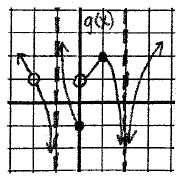
Q5. For the function shown in the graph, answer each part for each of the following values of : :
(a)
(b)
(c)
(d)
(e) Is in the domain of ? Why or why not?
(f) Is continuous at ? Why or why not?
Background
Topic: Limits and Continuity from a Graph
This question tests your ability to interpret a graph to determine one-sided and two-sided limits, function values, domain, and continuity at specific points.
Key Terms and Formulas
One-sided limit: (from the right), (from the left)
Two-sided limit: exists if and only if both one-sided limits exist and are equal
Function value: is the value of the function at (if defined)
Continuity at : is continuous at if is defined, exists, and
Step-by-Step Guidance
For each value of (), examine the graph of at and around .
To find , look at the -values as approaches from the left. For , look as approaches from the right.
Determine if the two one-sided limits are equal. If so, the two-sided limit exists and equals that value. If not, the two-sided limit does not exist.
Check if there is a filled (solid) dot at on the graph. If so, is defined and equals the -value of that dot. If there is an open circle, is not defined at that -value.
Decide if is in the domain of by checking if is defined (solid dot at ).
To determine continuity at , check if is defined, the two-sided limit exists, and equals the limit. If any of these fail, is not continuous at .
Repeat this process for each value of .
Try solving on your own before revealing the answer!
Final Answer:
For each value, the limits, function values, domain status, and continuity are as follows (read from the graph):
At : , , does not exist (one-sided limits not equal), is not defined (open circle), is not in the domain, is not continuous at .
At : , , does not exist, (solid dot), is in the domain, is not continuous at .
At : , , does not exist, is not defined (open circle), is not in the domain, is not continuous at .
At : , , does not exist, (solid dot), is in the domain, is not continuous at .
At : , , does not exist, (solid dot), is in the domain, is not continuous at .
For each , the function is not continuous because either the limit does not exist or the function value does not match the limit.
