 Back
BackAntiderivatives and Indefinite Integration
Study Guide - Smart Notes
 Tailored notes based on your materials, expanded with key definitions, examples, and context.
Antiderivatives
Definition of Antiderivative
An antiderivative of a function f(x) is a function F(x) such that the derivative of F(x) is f(x). In other words,
The process of finding an antiderivative is called antidifferentiation or indefinite integration.
The Antiderivative and Its Graphical Interpretation
Antiderivatives are not unique; if F(x) is an antiderivative of f(x), then so is F(x) + C, where C is any constant. This is because the derivative of a constant is zero.
Family of Antiderivatives: All functions of the form F(x) + C are called the general antiderivative of f(x).
Notation: The general antiderivative is written as .
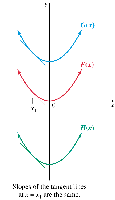
Additional info: The image illustrates that the graphs of antiderivatives differ only by a vertical shift (the constant C), but their slopes at any given x are the same.
Indefinite Integrals
Definition and Notation
The indefinite integral of a function f(x) is the set of all its antiderivatives, denoted by:
Integral sign (\int): Indicates the operation of integration.
Integrand: The function f(x) to be integrated.
dx: Indicates the variable of integration.
C: The constant of integration, representing all possible vertical shifts.
Basic Rules of Integration
Power Rule of Integration
For any real number n ≠ -1:
Example:
Constant Multiple Rule
The integral of a constant times a function is the constant times the integral of the function:
Sum and Difference Rule
The integral of a sum (or difference) is the sum (or difference) of the integrals:
Common Indefinite Integrals
Integral of
Integrals of Exponential Functions
, for ,
General Antiderivatives of Trigonometric Functions
Finding a Particular Solution: Initial Value Problems
Calculating the Constant of Integration
To find a specific antiderivative (a particular solution), you need an initial value (a point on the function). The steps are:
Find the general antiderivative .
Substitute the initial value into the equation: .
Solve for .
Write the particular solution using the found value of .
Example: If and , then . Substitute , : . So, .
Examples
Example 1
Find .
Solution:
Example 2
Find .
Solution:
Example 3
Find .
Solution:
Example 4
Find .
Solution:
Example 5
Find the particular solution to with .
General solution: . Substitute , : . So, .
Example 6
Find .
Solution:
Example 7
Find .
Solution:
Example 8
Find .
Solution:
Example 9
Find .
Solution:
Example 10
Find .
Solution:
