 Back
BackAntiderivatives and Initial Value Problems
Study Guide - Smart Notes
 Tailored notes based on your materials, expanded with key definitions, examples, and context.
Antiderivatives
Definition and Basic Examples
An antiderivative of a function f(x) is a function F(x) such that F'(x) = f(x). The process of finding antiderivatives is called integration. The general antiderivative includes a constant of integration, C, because the derivative of a constant is zero.
Notation:
Example:
Example: for
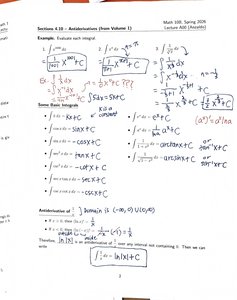
Common Antiderivative Formulas
Some basic antiderivatives are essential for solving integrals:
for
Properties of Indefinite Integrals
Linearity and Constants
Indefinite integrals have several important properties that simplify calculations:
for any constant
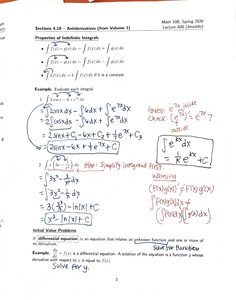
Examples of Evaluating Integrals
To evaluate an indefinite integral, apply the relevant formulas and properties:
Example:
Example:
Initial Value Problems
Solving Differential Equations with Initial Conditions
An initial value problem involves finding a specific solution to a differential equation that satisfies a given initial condition. The general steps are:
Integrate the differential equation to find the general solution (including C).
Substitute the initial condition to solve for C.
Example: If and , then . Plug in , to get , so .
Applications: Position, Velocity, and Acceleration
Relating Motion to Antiderivatives
In physics, the position, velocity, and acceleration of an object are related through derivatives and antiderivatives:
Velocity:
Acceleration:
To find position from acceleration, integrate twice, applying initial conditions for velocity and position.
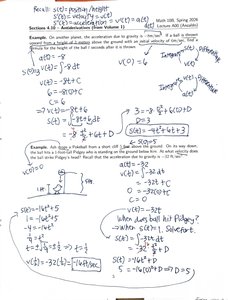
Example: If (gravity, in ft/s2), , :
Integrate :
Use to find
Integrate :
Use to find
Final position function:
Summary Table: Common Antiderivatives
Function | Antiderivative |
|---|---|
() | |
