Back
BackAntiderivatives and the Fundamental Theorem of Calculus
Study Guide - Smart Notes
 Tailored notes based on your materials, expanded with key definitions, examples, and context.
Antiderivatives
Definition of Antiderivative
An antiderivative of a function f on an interval I is a function F such that the derivative of F is f for all x in I:
for all in .

General Antiderivative
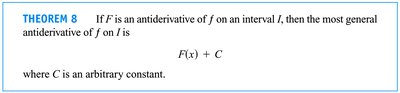
If F is an antiderivative of f on an interval I, then the most general antiderivative of f on I is:
where C is an arbitrary constant. This means all antiderivatives of f differ by a constant.
Family of Antiderivatives
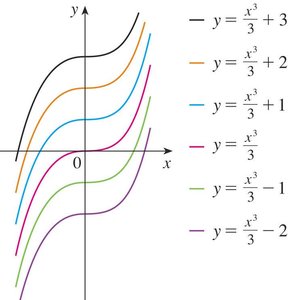
Assigning different values to C produces a family of functions, each a vertical translation of the others. For example, the general antiderivative of is .
Common Antiderivative Formulas
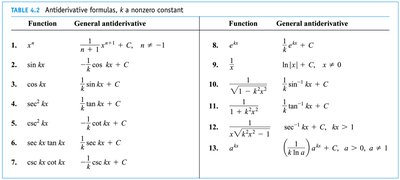
Some frequently used antiderivative formulas are summarized in the table below. These include power, exponential, logarithmic, and trigonometric functions.
Function | General Antiderivative |
|---|---|
, | |
, |
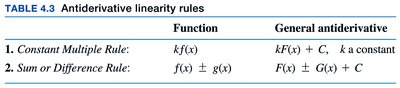
Linearity of Antiderivatives
Antiderivatives are linear, meaning:
Constant Multiple Rule:
Sum or Difference Rule:
Indefinite Integral
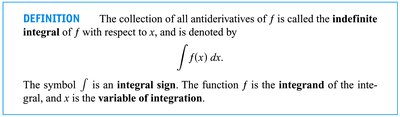
The collection of all antiderivatives of f is called the indefinite integral of f with respect to x:
Here, is the integral sign, f is the integrand, and x is the variable of integration.
The Fundamental Theorem of Calculus (FTC)
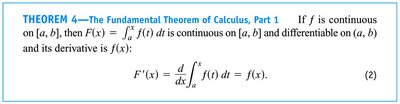
FTC Part 1: Differentiation and Integration as Inverse Processes
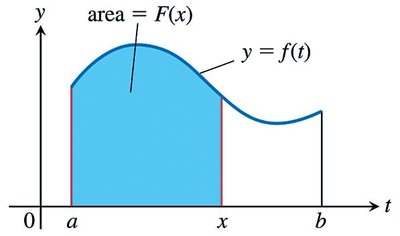
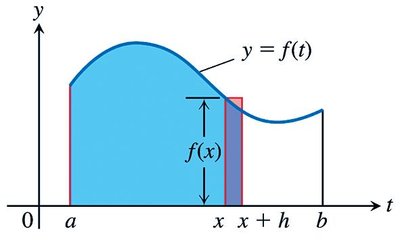
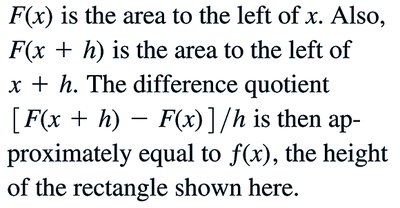
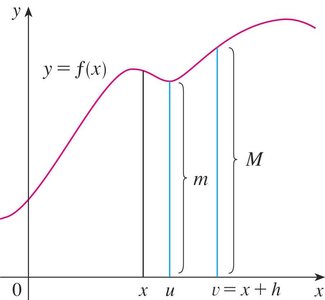
If f is continuous on , then the function is continuous on , differentiable on , and its derivative is :
FTC Part 2: Evaluating Definite Integrals
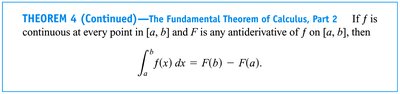
If f is continuous on and F is any antiderivative of f on , then:
Applications of the FTC
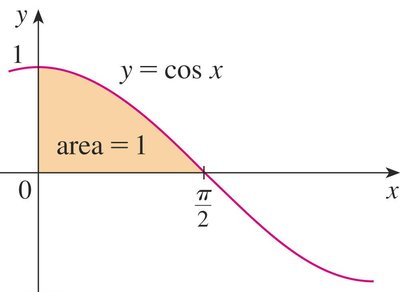
Area under a curve: The definite integral gives the net area between the curve and the -axis from to .
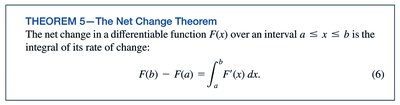
Net Change Theorem: The net change in a differentiable function over is the integral of its rate of change:
Worked Examples and Notes
Example: Find . An antiderivative is , so .
Example: Find . An antiderivative is , so .
Note: The FTC applies only to continuous functions on . If is not continuous (e.g., on ), the definite integral may not exist.
Inverse Processes
FTC1: Differentiating the integral of returns .
FTC2: Integrating the derivative of returns .
Handwritten Example Summary
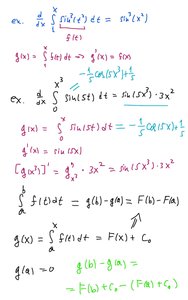
The handwritten notes illustrate the application of the FTC to compute derivatives of integrals with variable limits, and the use of the Net Change Theorem. For example, by the Chain Rule and FTC1.