 Back
BackApplications of Integrals: Volumes and Moments Using Cross-Sections
Study Guide - Smart Notes
 Tailored notes based on your materials, expanded with key definitions, examples, and context.
Volumes and Moments Using Cross-Sections
Volume of a Solid with Square Cross-Sections
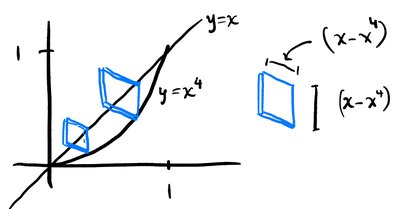
When a solid has a base bounded by two curves and cross-sections perpendicular to the x-axis are squares, the volume can be found by integrating the area of each square along the interval.
Base Region: The region is bounded above by y = x and below by y = x^4 for 0 \leq x \leq 1.
Side Length of Square: At each x, the side length is the vertical distance between the curves: s = x - x^4.
Area of Cross-Section: The area of each square is A(x) = (x - x^4)^2.
Volume Integral: The total volume is the integral of the area from x = 0 to x = 1:
Expanding and integrating gives:
Application: This method is commonly used to find the volume of solids with known cross-sectional shapes (e.g., squares, rectangles, semicircles) perpendicular to an axis.
Moment About the x-Axis for a Lamina
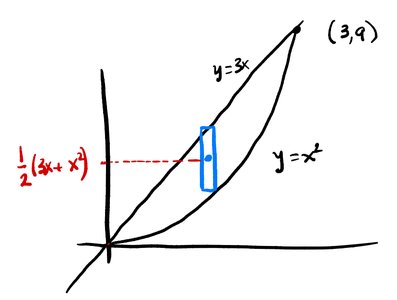
The moment about the x-axis (Mx) for a thin plate (lamina) of uniform density bounded by two curves can be found by integrating the product of the y-coordinate of the centroid of each thin slice and its area.
Region: Bounded by y = x^2 and y = 3x from x = 0 to x = 3.
Centroid of Slice: The y-coordinate of the centroid at each x is the average of the two bounding functions: \frac{1}{2}(3x + x^2).
Area of Slice: The area is the vertical distance between the curves: 3x - x^2.
Moment of Slice: Multiply the centroid by the area and integrate:
Expanding and integrating gives:
Application: The moment about the x-axis is used to find the center of mass and analyze the distribution of mass in a planar region.
Additional info: These problems illustrate the use of definite integrals to compute geometric and physical properties of regions bounded by curves, a central topic in calculus applications.
