 Back
BackApplications of Integrals: Volumes and Moments Using Cross-Sections
Study Guide - Smart Notes
 Tailored notes based on your materials, expanded with key definitions, examples, and context.
Volumes and Moments Using Cross-Sections
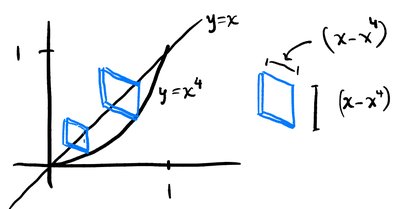
Volume of a Solid with Square Cross-Sections
When a region in the plane is bounded by two curves and perpendicular slices to the x-axis form squares, the volume of the resulting solid can be found by integrating the area of each square cross-section along the interval.
Region: Bounded above by y = x and below by y = x^4 for 0 ≤ x ≤ 1.
Cross-section: At each x, the side length of the square is x - x^4.
Area of cross-section: (x - x^4)^2.
Volume: Integrate the area from x = 0 to x = 1:
$V = \int_0^1 (x - x^4)^2 dx$
Expanding and integrating:
$V = \int_0^1 (x^2 - 2x^5 + x^8) dx = \left[ \frac{x^3}{3} - \frac{2x^6}{6} + \frac{x^9}{9} \right]_0^1 = \frac{1}{3} - \frac{1}{3} + \frac{1}{9} = \frac{1}{9}$
Final Answer: $V = \frac{1}{9}$
Moment About the x-Axis for a Lamina
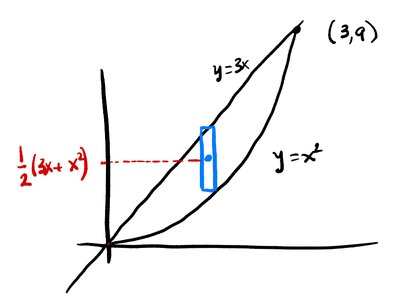
The moment about the x-axis (Mx) for a thin plate (lamina) of uniform density δ, bounded by two curves, is found by integrating the product of the y-coordinate of the centroid of each thin vertical slice and its area.
Region: Bounded by y = x^2 and y = 3x for 0 ≤ x ≤ 3.
Density: δ = 1 (uniform).
Area of thin slice: $(3x - x^2) dx$
Centroid y-coordinate: The average of the top and bottom y-values at each x: $\frac{1}{2}(3x + x^2)$
Moment of slice: $\frac{1}{2}(3x + x^2)(3x - x^2) dx$
Total moment:
$M_x = \int_0^3 \frac{1}{2}(3x + x^2)(3x - x^2) dx$
Expanding and integrating:
$M_x = \int_0^3 \frac{1}{2}(9x^2 - x^4) dx = \frac{1}{2} \left[ 3x^3 - \frac{1}{5}x^5 \right]_0^3 = \frac{1}{2}(81 - \frac{243}{5}) = \frac{1}{2}(81 - 48.6) = \frac{1}{2} \cdot 32.4 = 16.2$
Final Answer: $M_x = \frac{81}{5}$
Additional info:
The centroid y-coordinate for a vertical slice between two curves y = f(x) and y = g(x) is $\frac{f(x) + g(x)}{2}$.
The moment about the x-axis is used to find the center of mass (y-coordinate) of the lamina: $\bar{y} = \frac{M_x}{M}$, where $M$ is the total mass (area × density).
