 Back
BackApplications of Integration: Area Between Two Curves
Study Guide - Smart Notes
 Tailored notes based on your materials, expanded with key definitions, examples, and context.
Applications of Integration
Area of a Region Between Two Curves
The definite integral can be used to find the area of a region bounded by two curves. This is a fundamental application of integration in calculus, extending the concept from the area under a single curve to the area between two curves.
Key Objective: To find the area between two curves using integration.
Key Principle: The area between two curves is the difference between the area under the upper curve and the area under the lower curve over a given interval.
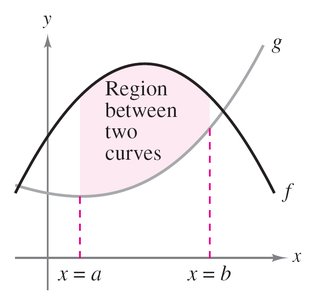
Geometric Interpretation
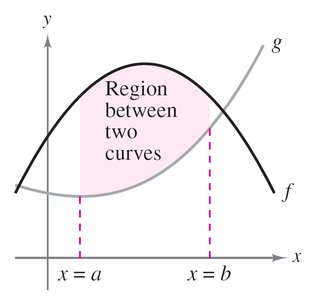
Suppose f and g are continuous functions on the interval [a, b], and for all x in [a, b], g(x) ≤ f(x). The area between the curves is the area under f minus the area under g.
The region of interest is bounded above by f(x) and below by g(x).
The area can be visualized as the sum of the areas of thin vertical rectangles spanning from g(x) to f(x).
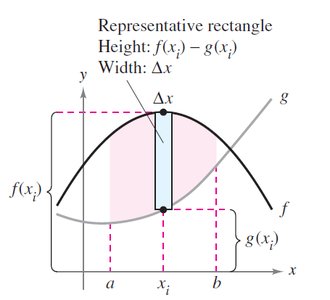
Definite Integral Formula
The area of the region between the curves y = f(x) and y = g(x) from x = a to x = b is given by:
Partition the interval [a, b] into n subintervals of width Δx.
The area of a representative rectangle is [f(xi) – g(xi)]Δx.
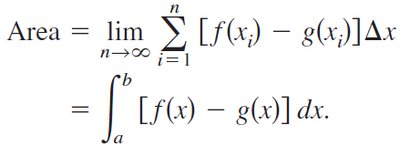
Summing these and taking the limit as n → ∞ gives the definite integral:
$ 
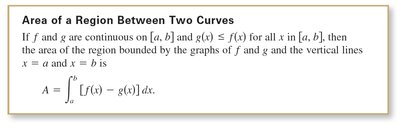
Summary Formula
If f and g are continuous on [a, b] and g(x) ≤ f(x) for all x in [a, b], then the area A between the curves and the vertical lines x = a and x = b is:
$ 
Generalization
The formula applies even if the curves are not both above the x-axis, as long as f(x) ≥ g(x) throughout the interval. The height of the representative rectangle is always f(x) – g(x), regardless of the position relative to the x-axis.
Representative Rectangles and Integration Variable
Representative rectangles are used throughout applications of integration. A vertical rectangle (width Δx) implies integration with respect to x, while a horizontal rectangle (width Δy) implies integration with respect to y.
Example 1: Area Between Two Non-Intersecting Curves
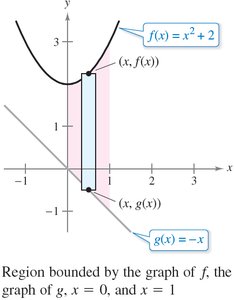
Problem: Find the area of the region bounded by y = x2 + 2, y = –x, x = 0, and x = 1.
Let f(x) = x2 + 2 and g(x) = –x.
On [0, 1], g(x) ≤ f(x).
The area is:
$ 
Area Between Intersecting Curves
When the curves intersect, the limits of integration are the x-values of intersection. These must be found by solving f(x) = g(x).
Example 2: Area Between Intersecting Curves
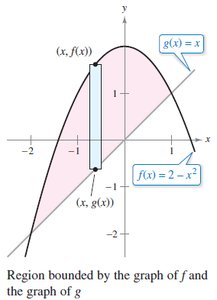
Problem: Find the area of the region bounded by f(x) = 2 – x2 and g(x) = x.
Set 2 – x2 = x to find intersection points: x = –2 and x = 1.
On [–2, 1], g(x) ≤ f(x).
The area is:
$ 
Integration as an Accumulation Process
Integration can be interpreted as the accumulation of infinitely many infinitesimal quantities. For area, this means summing the areas of infinitely thin rectangles across the interval.
The area formula is developed by summing the areas of rectangles and taking the limit as their width approaches zero.

Example 3: Area Bounded by a Curve and the x-axis
Problem: Find the area of the region bounded by y = 4 – x2 and the x-axis.
The area is:
$ 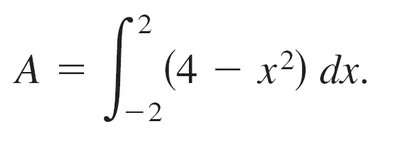
This integration can be viewed as the accumulation of the areas of rectangles as x moves from –2 to 2.
Summary Table: Steps for Finding Area Between Two Curves
Step | Description |
|---|---|
1 | Identify the functions f(x) (upper) and g(x) (lower) and the interval [a, b]. |
2 | If necessary, find intersection points by solving f(x) = g(x). |
3 | Set up the definite integral: |
4 | Evaluate the integral to find the area. |
