 Back
BackApplications of Integration: The Shell Method for Volumes of Solids of Revolution
Study Guide - Smart Notes
 Tailored notes based on your materials, expanded with key definitions, examples, and context.
Applications of Integration
Volume: The Shell Method
The shell method is a powerful technique in calculus for finding the volume of a solid of revolution. It is especially useful when the disk or washer method is cumbersome or requires multiple integrals. The shell method uses cylindrical shells to approximate and calculate the volume.
Objective: Find the volume of a solid of revolution using the shell method.
Comparison: Understand the advantages and differences between the disk and shell methods.
The Shell Method: Concept and Formula
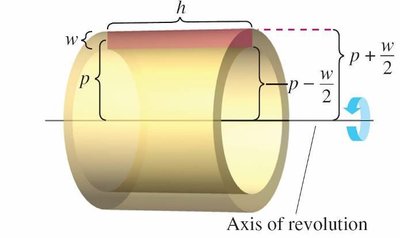
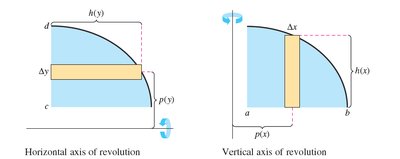
The shell method involves revolving a representative rectangle about an axis to form a cylindrical shell. The rectangle's width, height, and distance from the axis of revolution determine the shell's dimensions.
Representative Rectangle: Width w, height h, and distance p from the axis of revolution.
Shell Formation: When the rectangle is revolved, it forms a shell with thickness w.
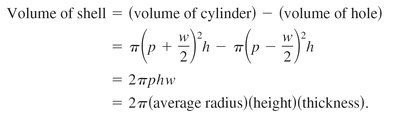
Volume Calculation: The volume of the shell is the difference between the volume of the outer and inner cylinders.
Shell Volume Formula:
The volume of a shell is given by:
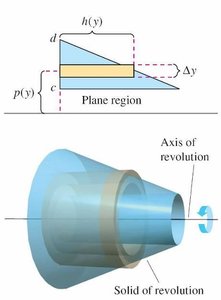
Shell Method for Solids of Revolution
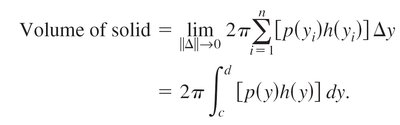
To find the volume of a solid, the region is divided into thin rectangles, each generating a shell when revolved. The sum of the volumes of these shells approximates the total volume, and as the thickness approaches zero, the sum becomes an integral.
Plane Region: A rectangle of width generates a shell when revolved about a horizontal axis.
Approximate Volume:
Exact Volume:

Shell Method Formulas
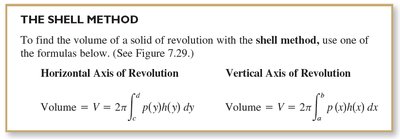
Depending on the axis of revolution, the shell method uses different variables for integration:
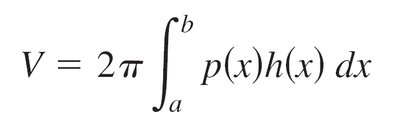
Horizontal Axis of Revolution:
Vertical Axis of Revolution:
Example 1: Using the Shell Method
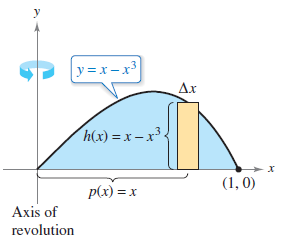
Find the volume of the solid formed by revolving the region bounded by and the x-axis () about the y-axis.
Axis of Revolution: Vertical (y-axis)
Representative Rectangle: Vertical, width
Distance to Axis:
Height:
Volume Integral:
Comparison of Disk and Shell Methods
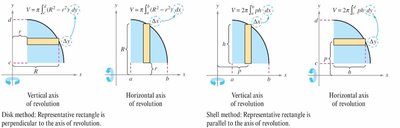
The disk and shell methods differ in how the representative rectangle is oriented relative to the axis of revolution:
Disk Method: Rectangle is perpendicular to the axis.
Shell Method: Rectangle is parallel to the axis.
Example 3: When Shell Method is Preferable
Find the volume of the solid formed by revolving the region bounded by , , , and about the y-axis.
Washer Method: Requires two integrals.
Shell Method: Requires only one integral, making it more efficient.
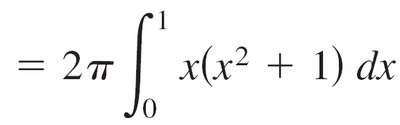
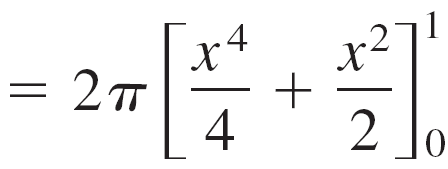
Shell Method Integral:
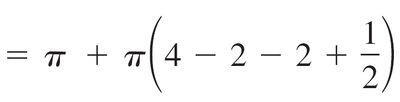
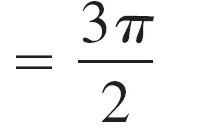
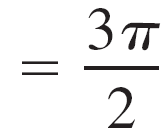
Evaluated:





Summary Table: Disk vs. Shell Method
Method | Rectangle Orientation | Integral Setup | Typical Use Case |
|---|---|---|---|
Disk/Washer | Perpendicular to axis | or | Simple boundaries, axis close to region |
Shell | Parallel to axis | or | Region farther from axis, complex boundaries |
Key Takeaway: The shell method is often preferable when the region is easier to describe in terms of the variable parallel to the axis of revolution, or when the disk/washer method would require multiple integrals.
