 Back
BackApplications of Integration: Volumes of Solids Using Disk, Washer, and Cross Section Methods
Study Guide - Smart Notes
 Tailored notes based on your materials, expanded with key definitions, examples, and context.
Applications of Integration
Volume: The Disk Method
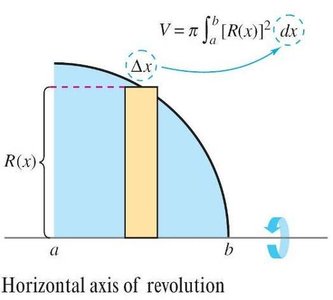
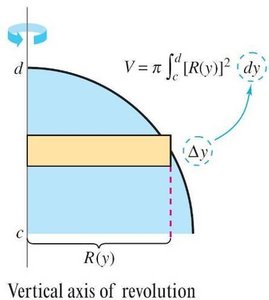
The disk method is a fundamental technique in calculus for finding the volume of a solid of revolution. When a region in the plane is revolved about a line (the axis of revolution), it forms a solid whose volume can be calculated using integration.
Solid of Revolution: A three-dimensional shape formed by rotating a two-dimensional region about an axis.
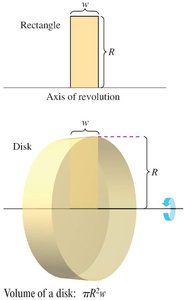
Disk: The simplest solid of revolution, formed by revolving a rectangle about an axis adjacent to one side.
Volume Formula: The volume of a disk is given by , where R is the radius and w is the width.
Generalization: For more complex solids, the region is divided into thin rectangles, each generating a disk when revolved.
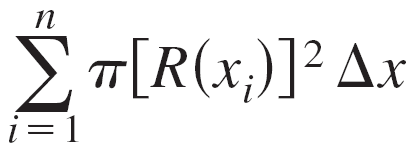
Approximation and Integration: The volume is approximated by summing the volumes of n disks:
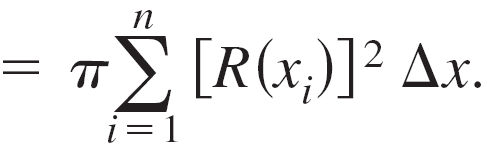
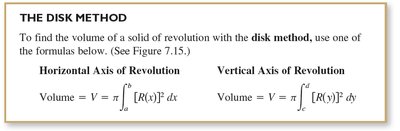
As the number of disks increases, the approximation improves, leading to the integral formula:

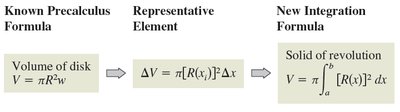
Horizontal Axis of Revolution:
Vertical Axis of Revolution:
Example: Disk Method
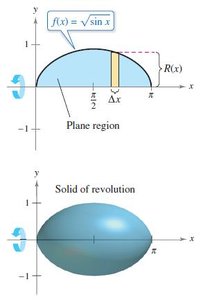
Find the volume of the solid formed by revolving the region bounded by and the x-axis () about the x-axis.
Radius:
Volume:
Volume: The Washer Method
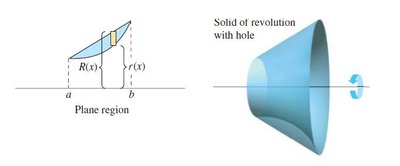
The washer method extends the disk method to solids of revolution with holes. Instead of a disk, a washer (disk with a hole) is used as the representative element.
Washer: Formed by revolving a rectangle about an axis, with inner radius r and outer radius R.
Volume Formula:
Generalization: For a region bounded by and , the volume is:
Example: Washer Method
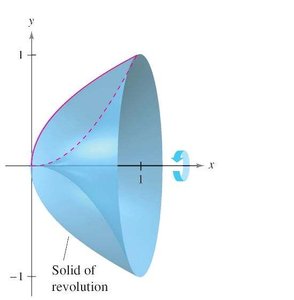
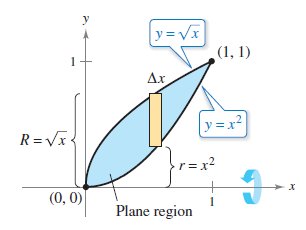
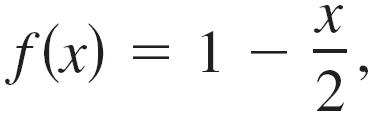
Find the volume of the solid formed by revolving the region bounded by and about the x-axis, for in .
Outer radius:
Inner radius:
Volume:

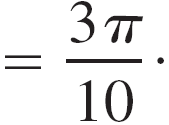

After integration, the result is:
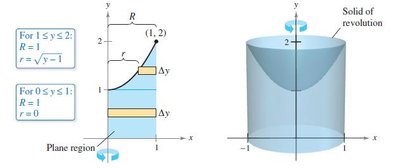
Example: Washer Method with Vertical Axis
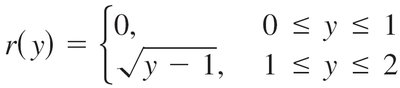
When the axis of revolution is vertical, integration is performed with respect to y. Sometimes, two separate integrals are needed if the inner radius changes form.
Outer radius:
Inner radius:
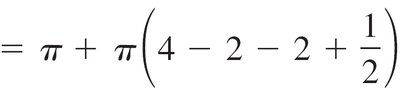
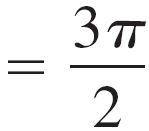
Volume:



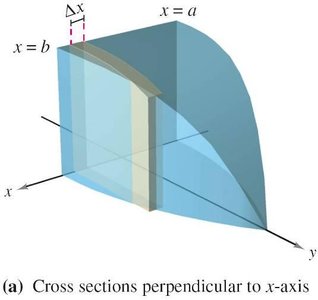
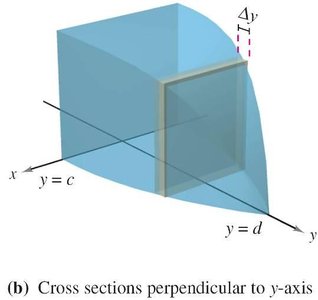
Solids with Known Cross Sections
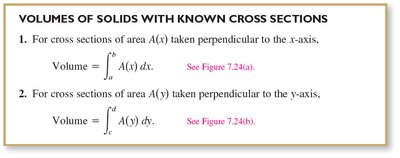
Volumes can also be found for solids whose cross sections are not necessarily circular. If the area of the cross section is known, integration can be used to find the volume.
Common Cross Sections: Squares, rectangles, triangles, semicircles, trapezoids.
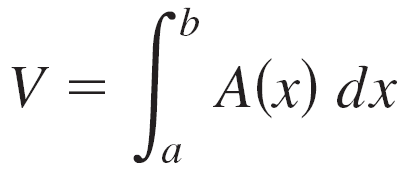
Volume Formula: For cross sections perpendicular to the x-axis:
Volume Formula: For cross sections perpendicular to the y-axis:
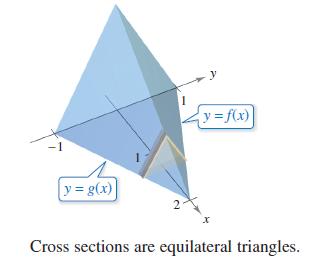
Example: Triangular Cross Sections
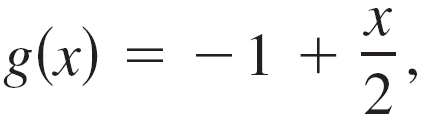
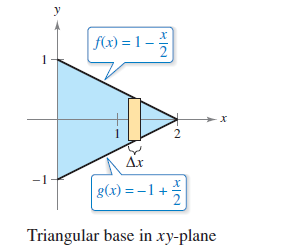
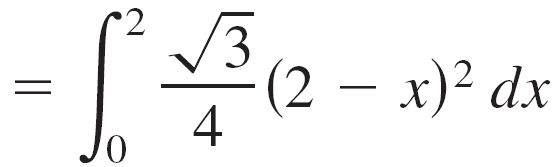
Find the volume of a solid whose base is bounded by and , with cross sections perpendicular to the x-axis being equilateral triangles.
Base length:
Area of cross section:
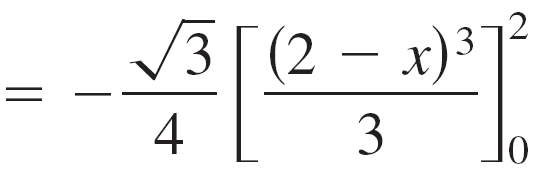
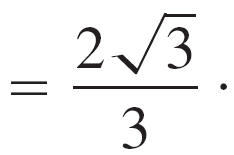
Volume:



Summary Table:
Method | Formula | Axis |
|---|---|---|
Disk | Horizontal | |
Disk | Vertical | |
Washer | Horizontal | |
Washer | Vertical | |
Known Cross Section | Perpendicular to x-axis | |
Known Cross Section | Perpendicular to y-axis |
Additional info: The notes provide a comprehensive overview of the application of integration to find volumes of solids, including the disk, washer, and known cross section methods, with detailed examples and step-by-step solutions.
