 Back
BackApplications of Integration: Work Done by a Force
Study Guide - Smart Notes
 Tailored notes based on your materials, expanded with key definitions, examples, and context.
Applications of Integration
Work
In calculus, the concept of work is a classic application of integration. Work is done when a force moves an object over a distance. The calculation of work depends on whether the force is constant or variable.
Work Done by a Constant Force
Definition and Formula
When a constant force F is applied to move an object a distance D in the direction of the force, the work W done is given by:

Units of Work
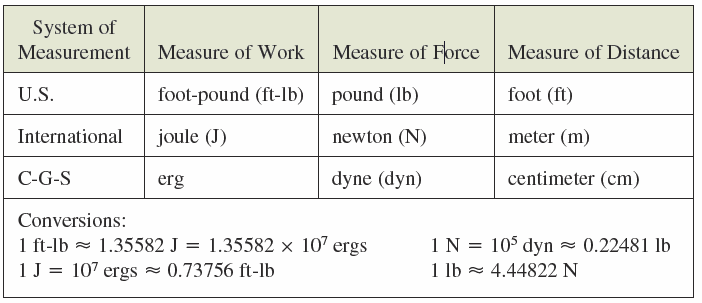
Work can be measured in different units depending on the system of measurement:
System of Measurement | Measure of Work | Measure of Force | Measure of Distance |
|---|---|---|---|
U.S. | foot-pound (ft-lb) | pound (lb) | foot (ft) |
International | joule (J) | newton (N) | meter (m) |
C-G-S | erg | dyne (dyn) | centimeter (cm) |
Common conversions include:
1 ft-lb ≈ 1.35582 J ≈ 1.35582 × 10⁷ ergs
1 J = 107 ergs ≈ 0.73756 ft-lb
1 N = 105 dyn ≈ 0.22481 lb
1 lb ≈ 4.44822 N
Example: Lifting an Object
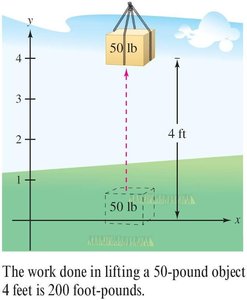
To find the work done in lifting a 50-pound object 4 feet:
Force, F = 50 lb (weight of the object)
Distance, D = 4 ft
Work, W = F × D = 50 × 4 = 200 ft-lb
Work Done by a Variable Force
Concept and Formula
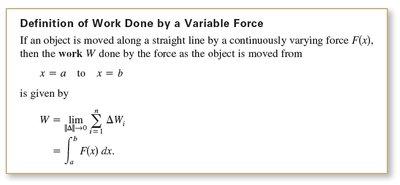
When the force applied to an object varies with position, calculus is required to compute the work. The work done by a variable force F(x) as an object moves from x = a to x = b is:
Physical Interpretation
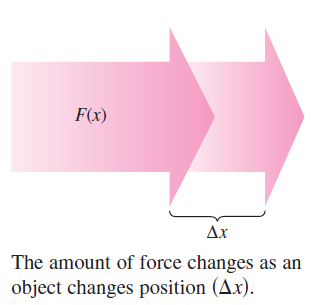
The force may change as the object moves, such as when compressing a spring or pumping fluid. The total work is the sum (integral) of the force applied over each infinitesimal distance.
Hooke's Law (Springs)
Hooke's Law states that the force required to compress or stretch a spring is proportional to the distance from its natural length:
where k is the spring constant.
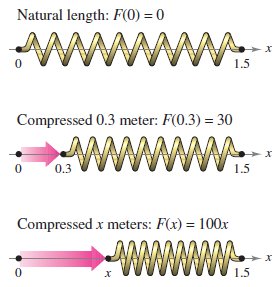
Example: Compressing a Spring
If a force of 30 N compresses a spring 0.3 m, and the spring is compressed an additional 0.3 m, the work done is:
Find k:
Work:
Evaluate the integral to find the work required.
Other Physical Laws Involving Variable Force
Newton's Law of Universal Gravitation:
Coulomb's Law (Electrostatics):
These laws describe forces that vary with distance and require integration to compute work over a path.
Applications: Work in Pumping Fluids
Example: Emptying a Spherical Tank
To find the work required to pump oil from a half-full spherical tank (radius 8 ft) through the top:
Oil weight: 50 lb/ft3
Divide the oil into thin disks at height y, thickness Δy, radius x.
Volume of disk:
Weight of disk:
Distance to lift:
Work for disk:
Limits for y: 0 to 8 (half-full tank)
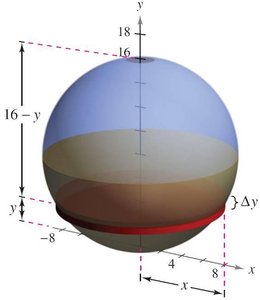
Using the geometry of the sphere, , so the total work is:
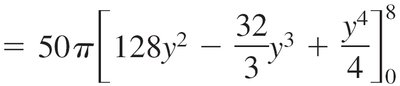
Expanding and integrating:

Evaluating the definite integral gives the total work required.
Reasonableness Check
Estimate the work by considering the total weight of oil and the average distance it is lifted. This provides a check on the calculated result.
Additional info: The examples and formulas above illustrate how integration is used to solve real-world problems involving work, especially when the force is not constant. These applications are foundational in physics and engineering.
