 Back
BackApplied Calculus: Syllabus and Course Structure Study Notes
Study Guide - Smart Notes
 Tailored notes based on your materials, expanded with key definitions, examples, and context.
Course Overview
This course, MAT-257: Applied Calculus, provides an introduction to the fundamental concepts of differential and integral calculus for single-variable functions. The curriculum emphasizes polynomial, logarithmic, exponential, and trigonometric functions, and integrates interdisciplinary applications and technology-based problem solving.
Key Topics Covered
Functions: Types, characteristics, and transformations
Limits and Continuity: Definitions, graphical and numerical approaches, one-sided and infinite limits
Derivatives: Rules, applications, and interpretation as rates of change
Applications of Derivatives: Curve sketching, optimization, and theorems
Integrals: Indefinite and definite integrals, area under curves, and substitution method
Applications of Definite Integrals: Volumes, arc length, and work
Transcendental Functions: Exponential, logarithmic, and trigonometric functions
Course Competencies
Analyze the principles of differentiation and integration, including limits and continuity.
Apply calculus techniques in mathematical and interdisciplinary contexts.
Evaluate complex problems using critical thinking and quantitative reasoning.
Construct curve sketches using differential calculus theorems.
Utilize mathematical technology and graphing calculators for advanced computations.
Module Structure and Learning Outcomes
Module One: Functions and Graphs
Identify and analyze various types of functions and their graphs.
Understand algebraic transformations (shifting, scaling).
Combine functions using arithmetic operations.
Evaluate trigonometric functions and their properties.
Module Two: Limits and Continuity
Analyze rates of change and slopes of tangent lines.
Calculate limits using algebraic and graphical methods.
Evaluate one-sided limits and continuity at points.
Module Three: Derivatives
Calculate derivatives at points and as functions.
Apply differentiation rules (product, quotient, chain).
Interpret derivatives as rates of change in real-world contexts.
Module Four: Applications of Derivatives
Identify extreme values using the Extreme Value Theorem.
Apply the Mean Value Theorem.
Analyze monotonicity and concavity using first and second derivatives.
Sketch curves incorporating calculus-based features.
Module Five: Integrals
Approximate area under curves using finite sums and sigma notation.
Evaluate definite and indefinite integrals.
Apply substitution in integration.
Module Six: Applications of Definite Integrals
Calculate volumes of solids using definite integrals.
Apply the method of cylindrical shells.
Evaluate arc length and work using integration.
Grading Scale and Policies
Grade | Quality Points | Description |
|---|---|---|
A | 4.0 | Exemplary: Exceeds all outcomes, demonstrates original thinking and critical analysis. |
B | 3.0 | Competent: Meets all or most outcomes, demonstrates some critical thinking. |
C | 2.0 | Target: Meets some outcomes, critical thinking is inconsistent. |
D | 1.0 | Approaching: Fails to meet most outcomes, lacks critical analysis. |
F | 0.0 | Missing: Fails to meet outcomes, lacks competence. |
Coursework Breakdown
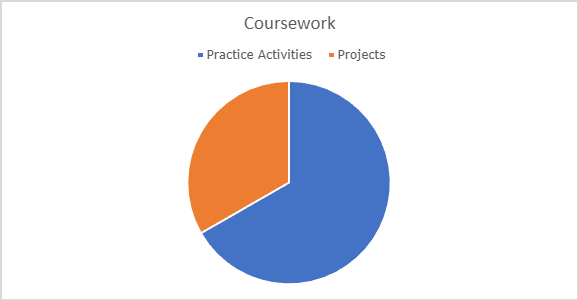
The coursework consists of practice activities (homework exercises) and larger projects, with an estimated total of 96.5 hours for completion. Practice activities reinforce concepts, while projects apply calculus to real-world interdisciplinary problems.
Major Course Resources
Thomas' Calculus (15th ed.) by Hass, Heil, Weir, & Bogacki
Desmos Graphing Calculator (online tool)
Additional Information
Accommodations are available for students with documented disabilities.
Grading policies and expectations are detailed in the IWU Catalog.
Note: This syllabus provides a comprehensive overview of the topics and expectations for success in Applied Calculus. Students are encouraged to use technology and critical thinking to master both theoretical and applied aspects of calculus.
