 Back
BackBasic Integration Formulas and Integration by Parts
Study Guide - Smart Notes
 Tailored notes based on your materials, expanded with key definitions, examples, and context.
Section 8.1: Using Basic Integration Formulas
Introduction to Basic Integration
Integration is a fundamental operation in calculus, serving as the inverse process of differentiation. The basic integration formulas provide a toolkit for evaluating a wide variety of integrals, especially those involving elementary functions such as polynomials, trigonometric, exponential, and logarithmic functions.
Basic Integration Formulas
The following table summarizes the most commonly used basic integration formulas. These formulas are essential for solving indefinite integrals and serve as the foundation for more advanced integration techniques.
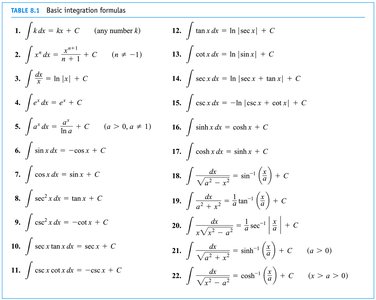
Power Rule: for
Exponential and Logarithmic Functions: ,
Trigonometric Functions: , , , etc.
Inverse Trigonometric Functions: ,
Hyperbolic Functions: ,
Example: To integrate , apply the power rule: .
Example: .
Section 8.2: Integration by Parts
Introduction to Integration by Parts
Integration by parts is a technique based on the product rule for differentiation. It is used to integrate products of functions where basic formulas are not directly applicable. The method transforms the integral of a product into simpler terms, often making the problem more manageable.
Integration by Parts Formula
The integration by parts formula can be stated in several equivalent forms:
Differential Version:

Function Version:

Definite Integral Version:

How to Use Integration by Parts
Identify parts of the integrand to assign as and .
Compute (the derivative of ) and (the integral of ).
Apply the formula: .
Example: To integrate :
Let (so ), (so ).
Apply the formula: .
Applications and Tips
Integration by parts is especially useful for products of algebraic and exponential, logarithmic, or trigonometric functions.
Sometimes, repeated application or rearrangement is necessary to solve the integral.
For definite integrals, always apply the limits after evaluating and the remaining integral.
Example: can be solved by letting , .
