 Back
BackCalculus Final Exam Study Guide: Limits, Continuity, and Derivatives
Study Guide - Smart Notes
 Tailored notes based on your materials, expanded with key definitions, examples, and context.
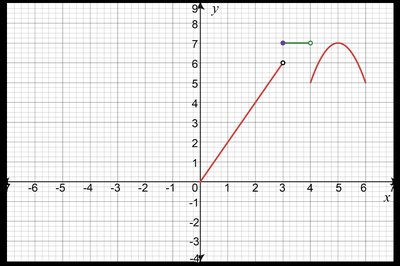
Q2. Refer to the graph of the function f(x) to find the given limit if it exists. If the limit does not exist, write "DNE." limx→5 f(x)
Background
Topic: Limits from a Graph
This question tests your ability to evaluate the limit of a function as x approaches a specific value by analyzing the graph. You need to determine the value that f(x) approaches as x gets close to 5 from both sides.
Key Terms and Concepts:
Limit: The value that a function approaches as the input approaches a certain point.
One-sided limits: The values approached from the left () and right ().
DNE (Does Not Exist): Used if the left and right limits are not equal or the function does not approach a finite value.
Step-by-Step Guidance
Examine the graph near . Look at the y-values that the function approaches as x gets closer to 5 from both the left and the right.
Check if the left-hand limit () and the right-hand limit () are the same. If they are, the two-sided limit exists and equals that value.
If the left and right limits are different, or if the function jumps or has a break at , then the limit does not exist (DNE).
Ignore the actual value of (the filled or open dot at ); focus only on the behavior as x approaches 5.
Try solving on your own before revealing the answer!
Final Answer: 7
As approaches 5 from both sides, the y-value of the function approaches 7. The function is continuous at this point, so the limit exists and equals 7.
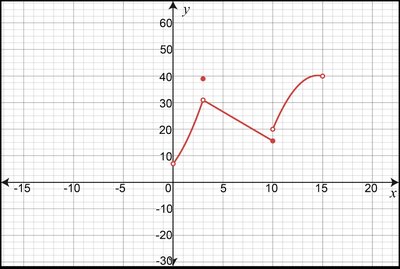
Q3. On the interval (0, 15), locate the points where the function f has discontinuities. For each discontinuity, indicate which continuity conditions are not met.
Background
Topic: Continuity and Discontinuities
This question asks you to identify where a function is not continuous by analyzing its graph. You must also specify which of the three continuity conditions fail at each discontinuity.
Key Terms and Concepts:
Continuity at a point a: A function f(x) is continuous at x = a if:
is defined
exists
Types of discontinuities: Removable (hole), jump, and infinite (asymptote).
Step-by-Step Guidance
Scan the graph for points where the function has a hole, jump, or is not defined.
For each discontinuity, check if is defined (is there a filled dot at x = a?).
Check if the left and right limits at each discontinuity are equal (does the graph approach the same y-value from both sides?).
Determine if . If not, specify which condition(s) fail.
Try solving on your own before revealing the answer!
Final Answer:
The function is discontinuous at because (removable discontinuity), and at because the limit does not exist (jump discontinuity).
