Back
Calculus I: Core Topics and Learning Objectives Overview
Study Guide - Smart Notes
 Tailored notes based on your materials, expanded with key definitions, examples, and context.
Core Course Topics
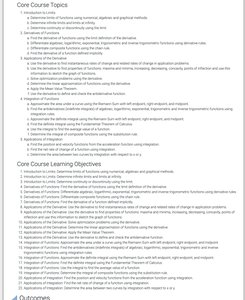
1. Definition of Limits
The concept of a limit is foundational in calculus, describing the behavior of a function as its input approaches a particular value. Limits are essential for defining continuity, derivatives, and integrals.
Numerical, algebraic, and graphical methods: Limits can be evaluated using tables of values, algebraic manipulation, or by analyzing graphs.
One-sided and two-sided limits: Understanding the difference between approaching from the left or right.
Infinite limits and limits at infinity: Describing unbounded behavior or end behavior of functions.
2. Definition of the Derivative
The derivative measures the instantaneous rate of change of a function. It is defined as the limit of the average rate of change as the interval approaches zero.
Definition using limits:
Interpretation: The derivative represents the slope of the tangent line to the curve at a point.
3. Techniques of Differentiation
Various rules and techniques are used to differentiate functions efficiently.
Product Rule:
Quotient Rule:
Chain Rule:
Differentiation of trigonometric, exponential, logarithmic, and inverse functions.
4. Applications of the Derivative
Derivatives are used to solve real-world problems involving rates of change and optimization.
Related rates: Finding how rates change in relation to each other.
Optimization: Maximizing or minimizing quantities in applied contexts.
Graph analysis: Using the first and second derivatives to determine intervals of increase/decrease, concavity, and points of inflection.
5. Definition of the Definite Integral
The definite integral represents the accumulation of quantities, such as area under a curve, and is defined as a limit of Riemann sums.
Definition:
Interpretation: Area under the curve between and .
6. Fundamental Theorem of Calculus
This theorem links differentiation and integration, showing that they are inverse processes.
Part 1: If is an antiderivative of , then
Part 2: The derivative of the integral function is .
7. Applications of the Definite Integral
Integrals are used to compute areas, volumes, and solve problems in physics and engineering.
Area between curves:
Volume by slicing, disks, and washers: where is the cross-sectional area.
Other applications: Work, average value, and more.
Core Course Learning Objectives
Upon completion of the course, students should be able to:
Define and evaluate limits using numerical, algebraic, and graphical methods.
Determine continuity and identify discontinuities in functions.
Apply the definition of the derivative and compute derivatives using various rules.
Analyze and sketch graphs using first and second derivatives.
Solve optimization and related rates problems.
Define and compute definite integrals using Riemann sums and properties of integrals.
Apply the Fundamental Theorem of Calculus to evaluate integrals and solve problems.
Use integrals to compute areas, volumes, and solve applied problems.