 Back
BackCalculus I Exam 1 Review: Limits, Continuity, and Asymptotes
Study Guide - Smart Notes
 Tailored notes based on your materials, expanded with key definitions, examples, and context.
Limits and Their Properties
Average Velocity Formula
The average velocity of an object over a time interval [a, b] is calculated using the change in position divided by the change in time:
Formula:
Application: Used to estimate instantaneous velocity as the interval shrinks.
Evaluating Limits from a Graph
To evaluate limits from a graph, observe the behavior of the function as x approaches a specific value from both sides. The limit exists if the function approaches the same value from the left and right.
Left-hand limit:
Right-hand limit:
Two-sided limit: exists if both one-sided limits are equal.
Limit Laws
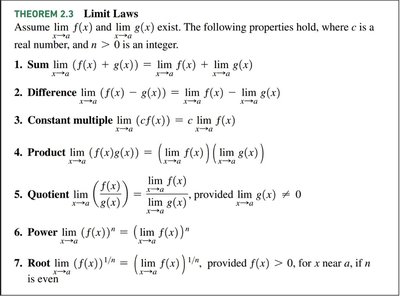
The following properties, known as Limit Laws, allow us to compute limits analytically when the limits of individual functions exist:
Sum Law:
Difference Law:
Constant Multiple Law:
Product Law:
Quotient Law: , provided
Power Law:
Root Law: , provided for even n
Evaluating Limits Analytically
To evaluate limits analytically, apply the limit laws and algebraic manipulation. For example, if and with as , then:
Infinite Limits and Asymptotes
Vertical Asymptotes
A vertical asymptote occurs at if the function grows without bound as x approaches a from either side:
If or , then is a vertical asymptote.

Limits at Infinity and Horizontal Asymptotes
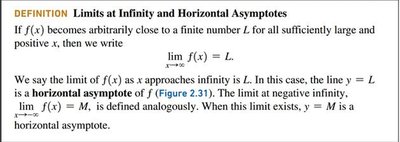
As x approaches infinity, if approaches a finite value L, then the line is a horizontal asymptote of :
Both and are horizontal asymptotes if these limits exist.
Infinite Limits at Infinity
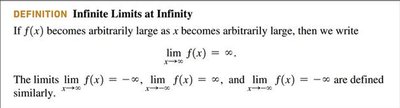
If becomes arbitrarily large as becomes arbitrarily large, we write:
Similarly, , , and are defined.
Limits at Infinity of Powers and Polynomials
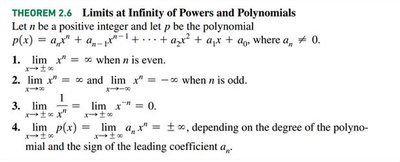
For polynomials and powers, the behavior as or depends on the degree and leading coefficient:
If is even: ,
If is odd: ,
,
For a polynomial , , depending on the sign of
Continuity and Discontinuity
Continuity at a Point
A function is continuous at if:
is defined
exists
Points of Discontinuity
A point of discontinuity occurs where a function is not continuous. This can happen if the function is not defined, the limit does not exist, or the limit does not equal the function value at that point.
Summary Table: Types of Asymptotes
Type | Definition | Equation |
|---|---|---|
Vertical Asymptote | Function approaches infinity as x approaches a | x = a |
Horizontal Asymptote | Function approaches a finite value as x approaches infinity | y = L |

