Back
BackCalculus I Midterm Study Guide: Limits, Continuity, Derivatives, and Applications
Study Guide - Smart Notes
 Tailored notes based on your materials, expanded with key definitions, examples, and context.
Limits and Continuity
Evaluating Limits
Limits are fundamental to calculus, describing the behavior of functions as inputs approach specific values. Calculating limits often involves algebraic manipulation, application of the Squeeze Theorem, or recognizing indeterminate forms.
Absolute Value and Oscillating Functions: For expressions like , the Squeeze Theorem is useful since and approaches 0.
Limits at Infinity: For rational expressions such as , divide numerator and denominator by to simplify.
One-Sided Limits: For , consider the sign and behavior as approaches 5 from the left.
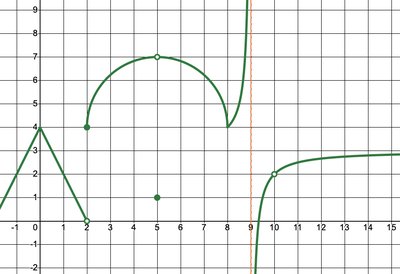
Types of Discontinuities
Discontinuities occur where a function is not continuous. They are classified as follows:
Removable Discontinuity: The limit exists, but the function is not defined or is defined differently at that point.
Jump Discontinuity: The left and right limits exist but are not equal.
Infinite Discontinuity: The function approaches infinity at the discontinuity.
Intervals of Continuity
A function is continuous on an interval if it has no discontinuities within that interval.
Identify intervals by examining the graph and noting where the function is unbroken.
Limit Evaluation from Graphs
Limits can be estimated from graphs by observing the behavior of the function as approaches a given value from the left and right.
Right-hand limit:
Left-hand limit:
Two-sided limit: exists if both one-sided limits are equal.
Derivatives
Limit Definition of the Derivative
The derivative of a function at a point measures the instantaneous rate of change. The formal definition is:
Apply this definition to to find algebraically.
Power Rule for Derivatives
The Power Rule is a shortcut for differentiating functions of the form :
For ,
Evaluating Derivatives at a Point
To find the slope of the tangent line at a specific point, substitute the value into the derivative:
For ,
Equation of the Tangent Line
The tangent line to at is given by:
For at ,
Applications of Derivatives
Velocity: Average and Instantaneous
For a position function , velocity is the rate of change of position:
Average velocity: over
Instantaneous velocity:
Finding Instantaneous Velocity
Differentiate the position function to obtain velocity:
For , use the quotient rule:
Solving for Zero Position
To find when , solve , and use the Intermediate Value Theorem to justify the existence of a solution in an interval.
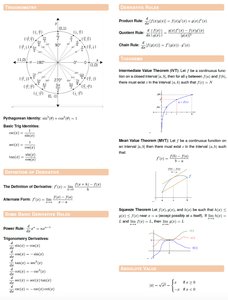
Key Calculus Formulas and Theorems
Basic Derivative Rules
Product Rule:
Quotient Rule:
Chain Rule:
Trigonometric Derivatives
Mean Value Theorem (MVT)
If is continuous on and differentiable on , then there exists in $(a, b)$ such that:
Intermediate Value Theorem (IVT)
If is continuous on and is between and , then there exists in such that .
Definite Integral Formula
, where is an antiderivative of