 Back
BackCalculus I Practice Test 3 – Step-by-Step Study Guidance
Study Guide - Smart Notes
 Tailored notes based on your materials, expanded with key definitions, examples, and context.
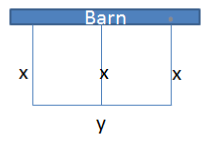
Q3. A dairy farmer plans to make two identical and adjacent rectangular pastures next to a barn. The total area must be 15,000 square meters. What dimensions will require the least amount of fencing?
Background
Topic: Optimization (Applied Maximum/Minimum Problems)
This problem is a classic calculus optimization scenario. You are asked to minimize the amount of fencing (perimeter) needed for a fixed area, using calculus to find the optimal dimensions.
Key Terms and Formulas
Area constraint: The total area of the two pastures must be 15,000 m2.
Perimeter (fencing) to minimize: The total length of fencing used for the sides and dividers (not including the barn side).
Variables: Let x = width of each pasture, y = length parallel to the barn.
Area formula:
Fencing formula: (since there are three vertical sections and two horizontal sections to fence)
Step-by-Step Guidance
Write the area constraint using the variables: .
Solve the area constraint for one variable in terms of the other. For example, solve for in terms of :
Write the fencing (perimeter) function in terms of a single variable by substituting the expression for into the fencing formula:
Simplify the fencing function:
To find the minimum fencing, take the derivative of with respect to , set it equal to zero, and solve for :
Try solving on your own before revealing the answer!
Final Answer:
The minimum fencing occurs when meters and meters (rounded to two decimal places).
This is found by solving for , then substituting back to find .
